
The way you approach Final Fantasy VII Advent Children will have a lot to do with your history as a gamer, and more specifically, your history with the Final Fantasy series. There is no way around it: Final Fantasy VII Advent Children is fan service. Glorious, beautiful, well-executed fan service. Those who enjoyed Final Fantasy VII and wanted to see the story continue get their wish wit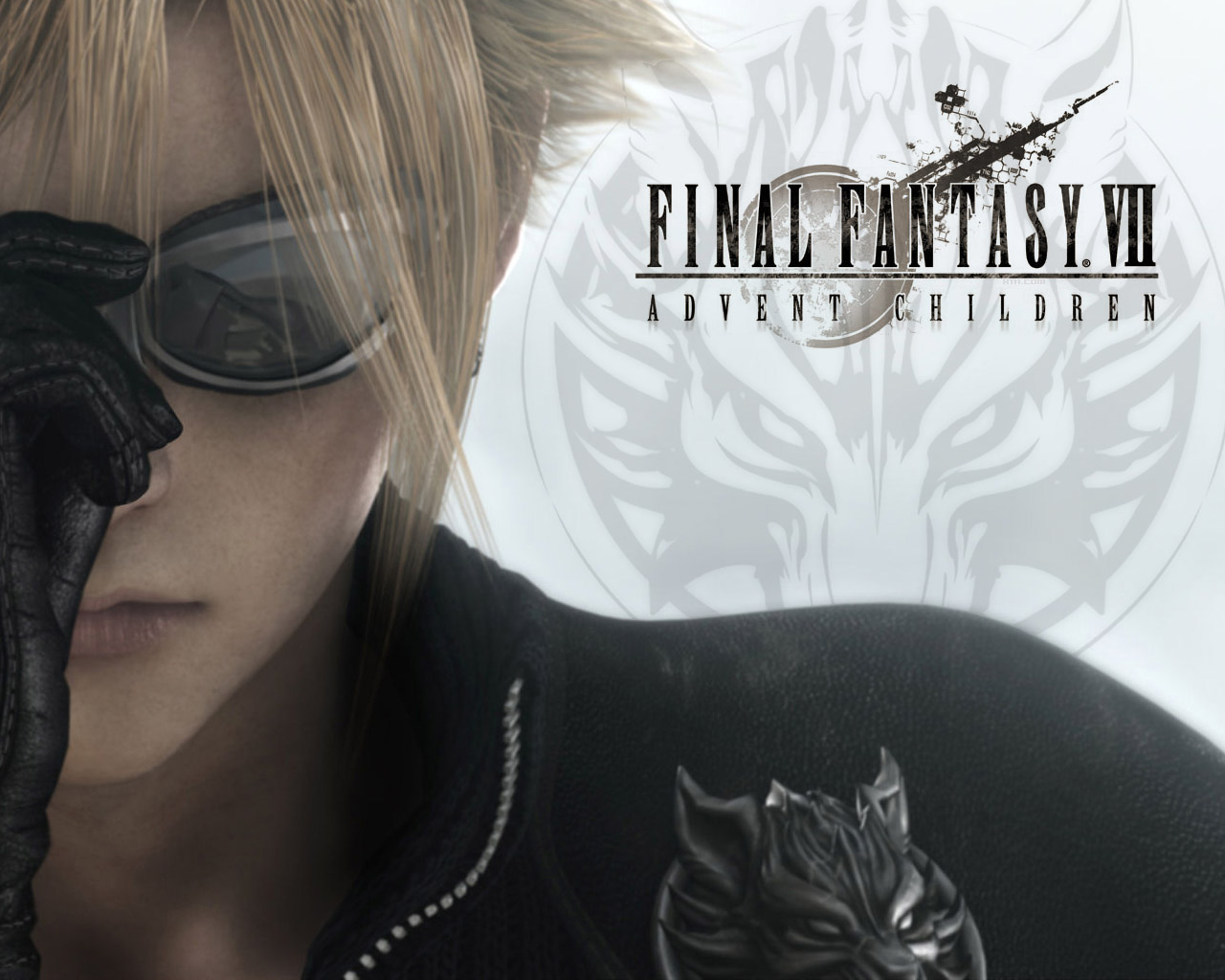
To everyone who considers anime a superior form of entertainment to American fare: Congratulations! You've just been tricked into watching a Hollywood movie. The plot is something that you could see at any multiplex theater between the months of May and August, and usually the rest of the year too. It's just an excuse to get the hero involved in some dazzling action scenes, and when it's all over, Cloud saves the day in an unsatisfying deus ex machina that leaves everything open to interpretation.
Unless you've played the game (or watched a friend play it, or seen some cosplay, or read some information online), there's no chance of getting to know the characters. Most sequels have that problem, but here it's magnified because the original was about 40+ hours' worth of gameplay. Compare that to a two-hour movie and that's a whole lot of back-story to catch up on. The movie tries to explain things with some introductory narration and willy-nilly flashbacks, but after trying to advance the story for 40 minutes, it just gives up and switches to pure action and fighting. There are even some cute comedy bits early on, but the lasting impression is one of fighting, fighting and more fighting. For old-time Final Fa
The action sequences are so kinetic and over-the-top that that border on the orgasmic. Characters leap and dive on-screen at a frenzied pace, pulling off some of the most ludicrously jaw-dropping action sequences you will ever see in any medium, ever, like a three-on-one sword fight performed on motorcycles at high speed, with each antagonist leaping into the air from motorbike to motorbike. It is actually too much to take at times, the pace so insane that the eye simply fails to keep up with the action on-screen. The synapses firing in your brain simply start rejecting the information being passed to it, like water overflowing from a sink. You find yourself laughing out loud at the utter absurdity of it. Simply put, you have never seen anything like the action in Advent Children. It is awesome in the literal sense of the word, in that it fills you with awe.
As for the animation itself, it is kind of frightening. Rendered entirely in CGI, the shocking advancements in compute

The inescapable fact is that Advent Children has been created like a video game, not like a film. Like a never-ending cut scene, it lives by different behavioral rules than we have come to expect from a film; it does not need to pay the same attention to explaining itself or having continuity from one sequence to another. One can argue that as a film, Advent Children fails to take these fundamental elements into account—like creating a story that its audience can actually follow—but all Advent Children sets out to do is absolutely blow your senses away; in this sense, the film is a magnificent success.
Just think, though—if some of that animation budget had been spent on story development, this movie could have transcended its status from high-priced fanfiction to a timeless work of art.
“It is the people in the industry who force boundaries onto animation… It’s all about cute girls, robots and explosions, to them. That’s not right. Movies like this [Tokyo Godfathers] exist and work.”
For most people, the anime genre has never represented more than an entertaining avenue for teenage fanboys and girls keen on violence, T&A and hyperkinetic animation. So that is why ev
Enter Tokyo Godfathers.
Tokyo Godfathers offers much more complicated characters and a very poignant plot that is a refreshing change of pace for anime.
Tokyo Godfathers, is a Christmas holiday tale with all the trimmings: a trinity of homeless people, an infant foundling, the glittering lights of a snowy metropolis, Tokyo-cum-Bethlehem. Despite being different from the typical holiday stories, the basic plot remains intact: adversity reigns until the child is found, fate smiles, and love wins the day.
In other words, high melodrama.
BUT! Tokyo Godfathers has good drama, it is unappealing since it features homeless people instead of cute boys or girls.
Furthermore, Tokyo Godfathers is also full of surprises. Laced with screwball comedy and high-speed action, the film encompasses more complex themes than the usual sugarcoated “spirit of Christmas.” It opens on Christmas Eve, as the homeless trio enjoys a modest celebration. Gin is a gruff, middle-aged drunkard tortured by the loss of his family. Hana is a gay former drag queen, still splendid with a powerful maternal instinct. Affectionately known as “Uncle Bag”, she looks after Miyuki, a willful runaway teen.
While searching through a trash heap, they stumble upon an abandoned baby
Kon’s weaving of storyline and circumstance is a display of narrative finesse (no loose ends here), but the good fortune pushes hard at the limits of believability. Then again, Tokyo Godfathers is a Christmas movie. Miracles are supposed to happen.
What makes most of these “miracles” bearable is that they are balanced by moments of broad humor. In one brilliant sequence, Gin has been savagely beaten by a youth gang, and lies bleeding in a dark alleyway. As the camera closes in on his battered face, we see a faint golden glow emerge off to the side. The camera pulls back to reveal a radiant angel standing over him. But just as the scene is about to devolve into utter cheesiness, the glow fades, leaving behind a bitchy drag queen in angel costume. Heavenly transcendence is an illusion; earthly salvation takes a humbler form.
Normally animators usually render surrounding objects in less detail than the object of focus. But for this movie, Kon insisted on detail for everything, from the windows on a skyscraper to the creases in a garbage bag. This creates a “hyper-real” vision of the city, making it seem grittier and more tactile. Kon applies a similarly amplified animation style to the charac
Unlike other holiday films, Tokyo Godfathers is not for the whole family. It incorporates many of society's problems, such as homelessness, random violence, and death. However, despite such grim topics, director Satoshi Kon is still able to tell a touching, funny, and hopeful story. In fact, telling the story amidst such bleak issues makes the film that much more impactful.
Tokyo Godfathers is a movie I would strongly recommend, and it is a nice alternative to the predictable, textbook holiday film.
"Why live in the world when you can live in your head?"
A lot of people who claim to out-and-out hate anime usually have a fairly good reason for that: a lot of anime is derivative of other, more succesfull anime. Granted, this is just like any industry, where the cool thing is immediately cl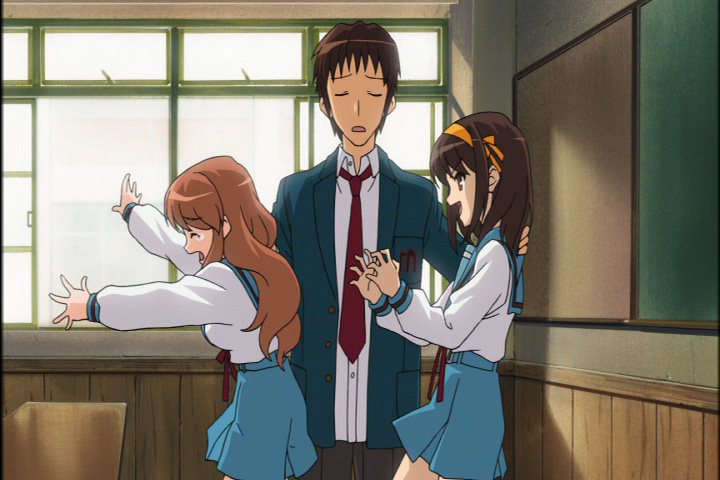
Every once in a while, though, something truly special comes along, an anime series that not only sets itself apart content-wise, but that does so by taking familiar genres and twisting them into imaginative new contortions. Think of how FLCL warped post-Evangelion giant robot conventions into a hormonal metaphor for teenage angst, and you might start to get an idea of what The Melancholy of Haruhi Suzumiya does to all kinds of shoujo fantasy subgenres.
An anime series made specifically for otaku usually fares no better than moderately well, as targeting it at whatever niche market it panders to inherently limits its potential appeal. Every so often, though, one finds just the right tone, or puts together just the right combination of gimmicks, to break beyond its limitations and become a smashing success. In 2006 that series was the megahit The Melancholy of Haruhi Suzimiya (hereafter MoHS), whose intrinsic oddity, bold characters, strong technical merits, and boatload of fan-pleasing gimmickry have won it immense popularity (or notoriety, depending on your point of view) in fan communities on both sides of the Pacific. Even its marketing campaign has been quite far off the beaten path, but one would expect nothing less from one of the most eccentric titles in recent years
MoHS wastes no time in revealing its eccentricities. Episode 00, which starts off the series, is actually composed of a grainy, deliberately amateurish film which features key cast members playing out a disjointed and horribly clichéd story narrated in off-the-cuff fashion by the one main character we don't see in it; all part of a project made for a school festival, we later discover, and the reactions of the cast members to seeing the completed film are classic. To open a series with something so deliberately bad that it's funny may be risky, but it certainly caught the attention of fandom. The real story actually begins with the second episode, which is numbered Episode 01. Though a person could actually entirely skip the first episode and not miss anything important to the plot, the novelty of the experience would be lost, as would an appreciation for the cleverness of the foreshadowing used in it; one of the conceits of the first episode, which only becomes apparent later on, is that the roles the key cast members play in the film are actually uncannily close to their true natures. Another oddity came in the fourth broadcast episode, which originally jumped ahead to episode 7.
Some of the series' charm also comes from the way it skewers assorted anime conventions and fandom peculiarities without exactly parodying them. It toys with the current Japanese otaku fascination with moe in the same way that a cat plays with a ball of yarn, addresses the “girl with glasses” fetish in two different ways, and unabashedly puts its two female leads in bunny costumes for the explicit purpose of exploiting sex appeal to gain attention. Its use of fan service carries a different feel from most other series, partly because it does not resort to the stereotypical tawdry reactions normally seen in more risqué
Most importantly, it revels in finding clever ways to explain the inclusion of fan-fave elements like psychics, aliens, time-travelers, and (for all practical purposes) gods in a normal high school setting. There are even hints of an underlying romance, as Haruhi's actions subtly suggest that her deigning to carry on conversations with the completely normal Kyon, and getting him involved in her schemes, may have deeper implications.
For all its slick use of story oddities, though, the central characters are the heart of the series' appeal. For decades anime titles have been replete with bold, assertive female leads that buck Japanese societal norms, but the title character here is in a class by herself. Rather than rely on partial insanity, hyperactivity, or stupidity, as most such heroines do, Haruhi achieves her dominance through sheer force of personality. She isn't crazy at all, as there is always a method to her seeming madness; she just has a unique world view, the audacity and aggressiveness to ruthlessly pursue it without being at all concerned with what others think, and apparently gets bored easily. Kyon, who also narrates, is at least as much of a delight as the low-key and somewhat cynical young man who increasingly finds himself mixed up in all the weirdness surroun
Though many aspects of the series may provoke discussion, it is still, at heart, a humorous otaku funfest (albeit an extremely good one), and is best appreciated if one does not lose sight of that. Haruhi is nothing short of a roller coaster joyride. It offers many unforgettable moments that you’ll cherish, as well as times where you’ll come close to dying of laughter. With its fresh sense of humor, stylized picture and plot, and characters you’ll absolutely never forget, The Melancholy of Haruhi Suzumiya may very well be the anime that defined 2006.
Perhaps the first season has left the Sunrise staff short on good ideas, but I honestly don’t think these folks took a step back to actually see what they were writing. While the story has spurts of absolute brilliance, the vast majority of episodes play out like fanfics, which can only be praised for originality and their ability to draw rabid fan reactions. The overall story is really a jumbled mess in serious need of an editor with a chainsaw.
So what exactly is the problem?
In a nutshell, R2 gets struck halfway through with a bad case of Sudden Shambolic Misdirection; this downturn in quality happens so inexplicably that I’m convinced the original production team got sacked and replaced with animation students on crack. Even in the beginning, R2 displays a couple of minor irritants which aren’t present in S1, such as incessant perverse shots of Kallen and an unnecessary influx of new and powerful characters. At first, these are easy to dismiss as temporary blips (after all, just watching Lelouch in action is exciting enough). Eventually, though, things begin to catch up with Code Geass – characters start doing things that don’t make sense and most of the shocking “twists” actually turn out to make no difference to the story later on.
Above all, what really hurts the series is the eventual sidelining of strategic interplay in favor of mecha battles so excessive that the show might as well rename itself Code Geass: I Wanna Be Gurren-Lagann So Bad.
Having said that, Code Geass has always been a franchise obsessed with results – it will sacrifice almost anything to deliver an almighty twist at the end of each episode. The same can be said of R2’s story as a whole; plotting and characterization (and yes, even the rules of chess) are crudely manipulated to make sure the series can deliver its ace in the hole. In those final few moments, the pointless twists and meaningless progression become vague memories lost in a single moment.
Indeed, for some this will be the only vindication necessary, or the miracle cure so to speak. However, I retain a healthy dose of skepticism for one very simple reason: while the final episode tries really hard to provide some delightfully poetic moments, simply knocking out a few great scenes can’t ever compensate for ten episodes of ill-conceived nonsense.
The writers of this show also need a remedial course on basic story writing because they have a bad tendency of following the “because I say so” form of storytelling. Instead of drawing from already established plot conventions, the writers clumsily tie the story into convoluted knots - which shoots logic in the foot - and shores everything up by making up a stupid explanation on the spot. In other words, if Lelouch were to somehow summon a magical, pink dragon that farts rainbows, it will be explained by a convoluted story about the history of Geass followed by blanks stares and a “because I say so.”
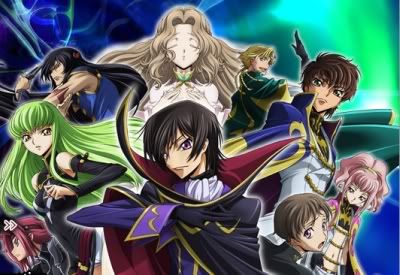
Nobody can claim that the cast of Code Geass has ever been superbly realized; in R2, however, they become downright incomprehensible. The best example of this is Lelouch himself. His goal at the beginning is clearly to protect Nunnally, but later, he starts to bounce from one contrived motivation to the other, confusing not just his companions, but also any discerning viewer. If Lelouch wasn’t so single-mindedly compelling, his final development would be a textbook example of how not to characterize a protagonist.
As for Cornelia, Kallen, Xinque and the rest of this colorful bunch, feel free to pick your favorites – it really doesn’t matter, because chances are they won’t end up doing much anyway. Too many times what appear to be brilliant new additions to the cast only end up hanging around like deadweight and even veteran cast members turn out to have no meaningful roles whatsoever. With each one falling prey to the story’s fickle whim, the ultimate effect is that too few of them remain interesting to watch in their own right.
Code Geass S1 is from beginning to end one of the most enjoyable anime of all time; conversely, Code Geass R2 is predominantly a big fat anti-climax. Conveniently, it delivers a hefty emotional punch at the last minute, ensuring in the process that it will be remembered with great fondness rather than bitter disappointment. In that sense the final episode could be read as a masterful move, although I think it’s more like dexterous trickery.
When all is said and done, any emotional connection made with R2 is only possible because of S1’s outstanding groundwork; for example, Lelouch remains sympathetic for miracles he used to perform as opposed to any of his actions here. As a standalone series, R2 is shamefully lacking; as part of a set of two, however, its worth lies in delivering the only thing S1 was missing – a finish.
Ultimately, how much you will enjoy Code Geass R2 is dependent on your opinion of the first season. If you think that the first season is mediocre or worse, skip this incarnation. If you think that season one is pleasure to watch, then expect the second season to be reduced to a guilty one.