
Another irresistibly goofy bit of fluff in Terry Pratchett's staggeringly popular Discworld series, Mort tells the tale of the title youth, a rather simple young man who is hired as an apprentice one evening by none other the ever-popular Death. At first, poor Mort finds himself ingloriously mucking out the Reaper's stables. But soon the boy is accompanying Death on his soul-gathering rounds, and not long after is actually taking Death's own horse (Binky) out and filling in for the old Reaper himself.
But when Mort, out of love and chivalry, prevents the scheduled demise of a pretty teenage princess, his actions cause a rift in the course of history from that point on, causing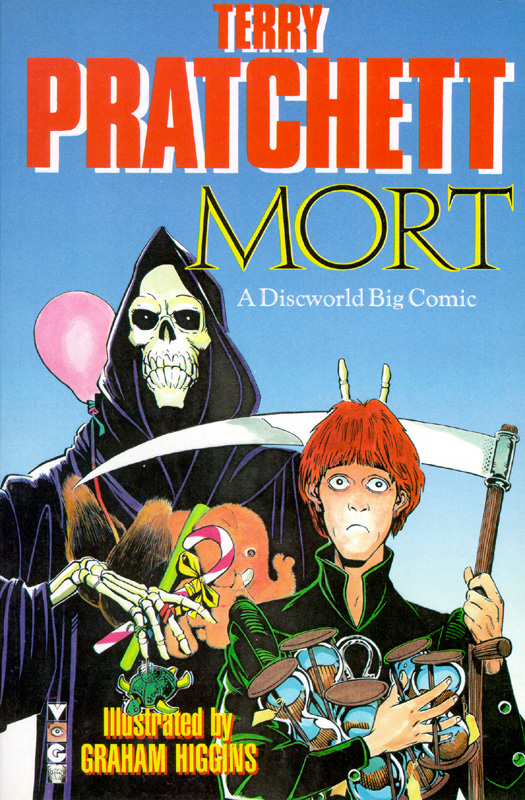
Yes, it is all rather silly for much of its length, and on first blush it seems to have all the substance of a bouquet of party balloons. But if there's one thing you can say about Terry Pratchett, it's that beneath the gags there's a really warm and endearing outlook on life, death, and the need to cherish the time we have before that time is, inescapably, up. While some of Pratchett's jokes are a tad too self-conscious (you can practically hear the laugh track accompanying them), quite often he's a droll fellow. The tales he spins are inventive, whimsical, and fun to read. Mort, after a shaky start with too many sarcastic dialogue exchanges and trite bits of slapstick including Death spoiling his air of ominousness by slipping on a patch of ice and that sort of thing, really begins to take off when the fantasy elements of the tale take precedence, and the humor starts to serve the story rather than vice versa. (Any untalented clod can string dorky gags and one liners together and try to pass it off as storytelling, but Pratchett is smarter than this.)
FAMOUS LAST WORDS
Pratchett's massive fan following won't need any recommendation from me to pick up everything in existence with his byline on it. Mort is a funny book, and Terry Pratchett is a funny man, a deft fantasist and a reliable ticket to a rainy day's good reading.
Brandon Sanderson matures remarkably in his second novel, a trilogy opener set in a land plagued by incessant volcanic ashfall and burdened by the millennia-long tyranny of its Lord Ruler, believed to be an embodiment of God himself. Here we see Sanderson warming to the tropes he likes best — a special class of people who possess carefully defined magic abilities; plucky heroines and roguish, devil-may-care heroes; the role of religion in how civilizations develop — porting them over from Elantris and allowing their thematic possibilities to flower. He is much more assured as a storyteller this time as well. He takes his time with Mistborn, allowing his characters and the almost stifling atmosphere in which he dresses his story to envelop you. With this book, Sanderson's considerable promise in Elantris is more than fulfilled. He's a major fantasy novelist.
Mistborn, had it simply been left to the contrivances of its plot, could have been just another groaningly tedious offering of the most clichéd premise that ever gathered dust in the storyteller's bargain bin: that of the valiant freedom fighter and his motley band of misfits sticking it to the man and waging war despite insurmountable odds against the forces of cruelty and oppression. Sanderson is a great deal more knowing than that, and casts his hero here as both a deconstruction and recapitulation of that archetype. Kelsier is a man on a mission. But though the Final Empire he battles is indeed appallingly brutal to its lo
But Kelsier isn't unlikable, because Sanderson lets his insecurities peek through the armor of his self-image. Amusingly, Kelsier is all too aware of his heroic reputation — betrayed years ago in an attempt to assault the Lord Ruler, and imprisoned in the Empire's most fearful mines, he is the only man ever to have escaped — and freely uses the awe his celebrity inspires to his advantage. Kelsier's ordeal led to the awakening of his powers as a Mistborn. And this, in turn, has made him a nearly legendary outlaw. In order to achieve his goals, Kelsier will come to realize he'll have no choice but to play out the legendary role he has built for himself to its logical ends.
As he did in Elantris, Sanderson is meticulous about establishing the rules of his story's magic. And the originality of his concept really elevates his book here. Mistings are people who can "burn" various metals (by ingesting them in a solution) to produce certain results. Brass allows you to make a person feel relaxed and amenable to doing your bidding. Steel lets you push against various metals. Pewter enhances your strength and stamina. That sort of thing. This is called Allomancy, and most practitioners can master only one metal. But a Mistborn can utilize them all.
It's a magic concept that Sanderson puts to extraordinary use in the book's action scenes, which, unlike Elantris, he spreads throughout Mistborn more carefully so that the novel's pacing flows through well-spaced dramatic peaks and valleys. Pushing and pulling on metals can practically allow flight. Simply by dropping coins on the ground and pushing against them, a Mistborn can propel himself to the roof of a high building. Fight scenes crash into white-knuckle chaos as literally every metal object in a room becomes a deadly projectile.
The story proper involves Kelsier's plan to overthrow the Lord Ruler, a task he treats with the glibness he might attach to knocking off a neighborhood jeweler. Ostensibly this is work-for-hire, as Kelsier is employed by another man. But behind the mask of his theatrical good humor and insouciance regarding near-certain doom lies a methodical mind driven by an implacable sense of duty and integrity, even if it is only to his own ideas about justice and retribution. His brother berates him, that everything's always all about him, not about the horribly subjugated skaa or anything so altruistic. Kelsier insists that's wrong. But we're not sure he's really being truthful until another player enters his life.
Vin is a young girl Kelsier rescues from a go-nowhere life working with a crew of small-time hoods. She comes to his notice when he detects her using Allomancy against no less than one of Lord Ruler's officials, and the audacity of the act spells doom for her whole crew. But Kelsier takes her under his wing when he realizes that she's a full-fledged Mistborn like himself. Innately distrustful (she's had it drilled into her head since childhood that anyone could and would betray her, by her own brother, who then promptly did so), Vin is not at all impressed by Kelsier's reputation nor his cocky, overconfident attitude. And even though she has nowhere else to go, she only agrees to join his crew and their seditious plans because she wants to see what happens. The story moves deliberately from their first meeting, as we see Vin grow from scruffy street urchin to savvy young woman through both Kelsier's magical mentoring, and the Pygmalion-like lessons she gets from his companions — in particular the scholarly and avuncular Sazed — that make an adult out of her. She's no hyper-focused, type-A manipulator like Elantris's Sarene, but a lot more down-to-earth, and all the more appealing for it. Kelsier himself grows up a little, too, thanks to his attachment to her, and the very real danger he knows he's put her in. For one thing, there's the curious matter that the Lord Ruler's fearsome Steel Inquisitors (truly badass villains indeed) seem far more interested in her than in him.
Vin's personal journey sees her forced to confront the distressing moral uncertainties that her companions' rebellion bring to light. Playing the role of a naive noblewoman, she has a hard time reconciling the beautiful and cultured people she meets at balls with the heartless plantation lords and aristocrats who are legally permitted to rape and murder skaa at their whim. Is Kelsier right to kill them with such casual disregard?
FAMOUS LAST WORDS
Sanderson is worlds better about not telegraphing major plot points as he did in Elantris. Though he still has a habit of setting off loud alarm bells with the way he establishes some supporting characters (gee, what is it with the wastrel nobleman Elend, and the way he ostentatiously spends his time reading books at formal balls and ignoring Vin — you think there's gonna be more to him than meets the eye?), the effect is much more appealing than eye-rolling this time. Mistborn is, on the whole, an admirably successful and impressive epic adventure, retaining all the entertainment value of Sanderson's debut while dialing down its Hollywoodish excesses. It promises fine things for the remainder of the trilogy to come, and cements Brandon Sanderson's credibility in the fantasy fold. If you want storytelling magic, Mistborn offers a little Allomancy of its own. This is heavy metal.
A Game of Thrones is a knockout, a bullseye, a touchdown, a home run. A gargantuan fantasy saga set in a world where seasons last years, it earns the right to be called an epic by virtue of its sweeping and engrossing story, and the most believable and human cast of characters to populate a fantasy. Sure, it's a bit of a chore to keep track of all of them, but Martin rewards stalwart readers with the kind of story most fantasy writers can only dream of pulling off. Multiple plotlines abound, intrigues pile upon intrigues, and virtually none of it flags or falters despite the book's nearly 900-page length. While many fantasy authors seem to think that all you have to do to write an epic novel is make it really, really long, Martin knows you've gotta fill all those pages with a narrative that keeps your readers glued.
Martin's epic is set in the Seven Kingdoms of Westeros, on a world in which summers can last a decade or more, and winters nearly a century. 
Eddard's appointment begins under a cloud. One of his youngest sons, Bran, nearly dies in a horrible fall that leaves him paralyzed and comatose, and which we know was no accident. Bran has inadvertently stumbled upon one of Cersei's darkest secrets, and nearly pays with his life. After Eddard is miles away from Winterfell, at court in King's Landing, Bran awakens from his stupor, and though he cannot remember what it was he saw, Catelyn and the eldest Stark son, Robb, are now convinced that the Lannisters are up to absolutely no good. Catelyn hurries off to King's Landing to warn her husband, leaving Robb in charge of Winterfell, a 15-year-old boy suddenly thrust into the position of Lord.
A host of brilliantly drawn characters brings the saga to life. Among the more memorable are Tyrion Lannister, the black sheep of the Lannister clan, stunted by dwarfism. At first the one member of Cersei's family remotely sympathetic to the Starks, he finds himself swept up in the growing turmoil between the two families until all of his skills at conniving must be brought to bear simply to stay alive. Jon Snow, a bastard son of Eddard's, rejected by Catelyn, joins the Night's Watch, a legion whose duty it is to guard an immense wall far to the north, beyond which lies a fearsome supernatural threat to the Seven Kingdoms. And in a fascinating subplot, we meet princess Daenerys Targaryen, one of the last surviving heirs to that unseated regime. Living in exile in a land far across the ocean (the book doesn't even provide a map to it) and having been wedded to a savage but noble warlord, she dreams of returning to her homeland one day and seeing the Targaryen name and its power restored.
Martin has an ability to go for the gut that most of his contemporaries in the fantasy genre simply lack, because they also happen to lack his character development skills. Whether in its bloody and violent battle scenes or in its intimate portrayal of the bonds of family and brotherhood, A Game of Thrones has a raw emotional force that hits you where it counts. Much of the time you do feel you're being manipulated — there are certain characters you simply want to see die in the most agonizing possible way, and occasionally Martin pays off — but it's being done so well you really don't mind.
There is an exhilarating quality to this story that has been absent in fantasy, which has in turns been stultifed by literary pretensions or hamstrung by recursive, self-referential humor, for who knows how long. Martin's tale mostly dispenses with such post-Tolkien clichés as wizards and elves and spells and dark lords, turning its focus to real people and only hinting at supernatural or mystical goings-on behind the scenes. In spite of its length, the tale rarely flags in its pace. Martin's conceit of finishing most of his chapters with a cliffhanger keeps you wired, athough the multicharacter and multiplot nature of the story can make it terribly frustrating when you're presented with a shocking turn of events only to be suddenly thrust into another scene, without being able to get any sort of resolution for another 60 or so pages. But mostly, Martin balances his story well, leaving, in the end, only a few characters' narratives lacking closure — a situation successfully calculated to have you clamoring for the next book.
FAMOUS LAST WORDS
Dazzling in the scope of its legendry and in its heartfelt humanity, A Game of Thrones signals the onset of perhaps the most significant work of fantasy since Bilbo found the One Ring. True, that is a claim that critics and readers have made time and time again about virtually every fantasy saga to see print, but until now, in all honesty, it's been hyperbole. With A Song of Ice and Fire, it may well be true. This is one that will go beyond the status of bestseller into honest-to-goodness classic.
You may have been either avoiding this book or worse, unacquainted of its entire existence but I suggest you catapult away from any hesitation you retain and read this book . Don't be swayed by the befuddling synopsis or self-described pundits spatting the book every way they can, Catch-22 isn't just a piece of satirical anti-war fiction, mind you, it's much more than that.
An unconventional novel arose from the hand of an unknown author to the stature of a world classic and its messages remain relevant, nay, prophetic for all ages.
For the most part, the many characters carry out their tasks without questioning their own activities or their leaders; they seem happy simply to occupy their time.
Yossarian stands out of this crowd because he asks many questions. He wants control of his life, he wants to live, he “was willing to be victim to anything but circumstances.”
Wanting to escape the bureaucratic machinery makes Yossarian look like a coward to most people around him. For this reason, he is the protagonist, but not exactly a hero in the traditional or conformist sense – he is the anti-hero.
This novel’s world flourishes with characters moving about as an army of 
Yossarian and Dunbar stand out almost as villains. Yossarian flows against the social current as the anti-hero; he recognizes the absurd logical loops by which others around him consider their lives perfectly normal.
Although most people might view WW II as a highly justified war, it nevertheless played out with all the graft, corruption, and big-money contracts as any other. WW II ushered America into the world theater as a superpower with the moral credibility that would feed the ego-centric hubris of a sleeping giant with an unmatched thirst for power.
Every decade that followed WW II showed America how to become an empire at the cost of the republic, how to garner an emperor’s war power for the President, at the cost of Congressional restraint.
Catch 22 captures the essence of the credulous, poorly educated, and uncritical citizens who follow mindlessly the Pipe Piper of bureaucratic institutions from government, military, and big business.
Heller began writing this novel in the late 1950’s to see it first published in 1961. This period saw the rise of the Truman Doctrine and the Cold War era during which the U.S. fought to ward off any spread of communism in places like Korea.
In order to uphold the Truman Doctrine, the U.S. military budget began its exponential growth into what now fattens into the largest military spending in world history. Heller’s novel satirizes this transformation of America from a republic into an empire that runs on a bloating bureaucratic military-industrial complex, the dangers of which Eisenhower warned.
Given this background, Catch 22 reflects a larger transformation of America than simply a reaction to the Vietnam War. In fact, by 1964, the Gulf of Tonkin incident occurred and the U.S. was just beginning to escalate toward an official and publicly recognized conflict in Vietnam.
The novel reveals the logical loops in which the citizens run about in their daily occupations. All people need is a logic, an ideology, a belief system to guide them, and they’ll do whatever the program requires for the sake of fitting-in and getting along in life. Catch 22 is a law structured in mindless, uncritical circles.
This circular and absurd logic pervades throughout this story, in almost every conversation between the characters, in their actions and thoughts. It creates an eerie Kafkaesque atmosphere that continues through the real world.
This looping logic could not be more obvious than in America’s present war in Iraq. As a timeless classic, one can now read Catch 22 as if it were written today.
Bush Jr.’s initial justifications for his blind invasion of Iraq were based on lies, now obvious and abundantly proven, about imminent threats of WMD’s and later of terrorism.
When these reasons were proven as valueless as the large quantities of chocolate covered cotton that Heller’s seemingly innocent entrepreneurial character, Milo Minderbinder, sells, Bush Jr. explained that the war was necessary because terrorists overran Iraq. Of course, this statement spins in its own circle because regular Iraqi citizens as well as foreign intruders appeared on the scene as insurrectionists only after the U.S. occupation.
When this reason for war no longer sufficed, Bush Jr. told Americans that we must continue fighting in order to honor the soldiers already killed in battle. Obviously this logic, too, loops on itself into an absurd infinity. If Americans were silly enough to follow this logic, soldiers would go to war endlessly in search of honor of those who died before them regardless of whatever the initial reasons were at the war’s beginning.
We know about the lemmings, the small rodents who run over the cliff only because their companions did so before them. Once the program is put into place, no American is really silly enough to run in step like a mindless hamster on its exercise wheel.
Likewise, the many Generals and other military leaders at the Pentagon could have resigned when they first opposed the unplanned, unjustified invasion. Instead, they held onto their careers and their government salaries, despite their courage to serve the greater good of the country.
Americans are much smarter than that. But then, sometimes reality plays out more phantasmagorically than the most wildly imagined satirical fiction. Sometimes reality is less believable than fantasy.
In Catch 22, Milo Minderbinder’s commercial operations reveal the only realistic reasons for the war despite the double talk of ideological calls to freedom, liberty, and democracy. Economic power drives men to many places and to many endeavors.
Milo Minderbinder represents the small time entrepreneur working the black-market. He claims that his growing enterprise offers benefits. “Every man will have a share.”
Compared to Colonel Carthcart, who sends his men to death only for the sake of his own promotions, Minderbinder’s profiteering seems moral, at least until he does a deal with the Germans to bomb his own squadron. Then his syndicate takes on the power of a multinational that no state laws or national loyalty can restrain.
Again, reality proves more surreal than the fictional satire. During the cavalier cowboy gunfight in Iraq, one wonders where the $9 billion of tax money disappeared?
FAMOUS LAST WORDS
Dig into the "Shadow" novels that make up what might be called the "second wave" of Orson Scott Card's Ender saga, and you'll find books that stand in sharp contrast to the three novels that followed Ender's Game itself. Those titles — Speaker Of The Dead, Xenocide and Children Of The Mind — were deeply contemplative and centered on the relationships between Ender and a host of, shall we say, rather emotionally tortured characters. The Shadow novels retain the interest in interpersonal dynamics (Card is basically incapable of writing any novel that lacks such a focus), but the narrative goals are all about action and suspense this time, without asking so much from the reader in the way of a furrowed brow.
Following Ender's victory against the Formics, the world is a changed place. With the alien enemy defeated, humanity, once united under the Hegemon, has quickly settled back into business as usual. Nations reestablish themselves and rattle sabers. A new world order is indeed in the offing. Ender is quickly shipped off to a colony world to calm global concern over what America might do, led by such a great military leader. And the remaining graduates of Battle School return to their home countries to try to settle into a life they never really grew up enough to know in the first place.
The new X factor is Achilles de Flandres, Bean's bete noire from his childhood as a Rotterdam street urchin. Achilles is psychotic, but a cunning manipulator. Having gotten kicked out of Battle School by Bean, Achilles has ingratiated himself to the Russian government, and he arranges for the abduction of every member of Ender's "jeesh," the Dragon Army — the Battle School platoon he commanded in his victory against the Formics. Power hungry countries all want Ender's former soldiers under their control, as valuable assets in whatever wars yet loom on the horizon. But Achilles has plans of his own, and finds more than enough power hungry countries eager to be led, and misled, by his machinations.
Bean is singled out for special treatment by Achilles, who just tries to assassinate him outright. Bean, the ultimate survivor, tries to stay one step ahead of Achilles' plans. With his s
Shadow of the Hegemon is a political and military thriller, straight up. What it lacks in intellectual and thematic muscle it tries, more or less successfully, to make up for with white-knuckle excitement. It's enjoyable on those terms, though too often, events click too conveniently into place in order to get the plot where Card wants it to go. For instance, given their centuries of mutual animosity, it's v-e-r-y hard to believe that even Achilles could be such a winning and charismatic person as to persuade both India and Pakistan to withdraw its armies from one another's borders with a heap of sugar-coated and all too clearly bogus promises — and do so in the space of a single high-level meeting with Pakistan's leader.
Its hard to ignore, in fact, the problems here are too plentiful for me to elaborate on, but here's a quick list. With few exceptions, the characters all talk the same way and think the same way; any differences don't emerge from what the characters do but instead are told to us--explicitly--by Card in excruciating internal monologues. Unlike in Ender's Game, where the Battle School children were still unmistakably children, here the fact that most of the chief players are under 20 hardly plays a role in the story. Achilles is a terrible villain; neither terrifying nor sympathetic, he spends the book as a plot device, raising problems that Bean (and his friends) can go in and fix. The character of Peter Wiggin is massacred--massacred!--compared to his depiction in Ender's Game. The second chapter of Ender's Game alone, when Peter nearly kills Ender and then cries by Ender's side afterward, still sends chills down my back; no scene with Peter in Shadow of the Hegemon made him out to be anything other than another plot device.
I know these books predate the Matt Damon Bourne movies, which were casually based on the Robert Ludlum novels. But with their slick pacing and sense of urgency laced with paranoia, they subscribe to much the same race-against-time escapist sensibility. If Shadow of the Hegemon were a movie, it would be shot entirely with hand-held cameras and be edited by someone whose Ritalin was withheld from him until he finished the job.
FAMOUS LAST WORDS
Okay, so maybe the book isn't that frantic. But while readers who have followed this series from the start may find themselves disappointed to see the whole thing steering towards popcorn entertainment, I kind of found it refreshing that Card was able to deliver such a novel at a point in his career that many fans had begun to believe was inching past its sell-by date. Or perhaps it was simply that, having gotten all of the spiritual angst wrung out of the tale following the exceedingly serious Xenocide and Mind, and riding the wave of renewed goodwill that followed the surprising artistic success of Enders Shadow, Card decided it was time to give Ender fans a plain old-fashioned ripping yarn.
Thing is, he delivered the whole package in Enders Game. So despite its pleasures, Shadow of the Hegemon is yet a shadow of this saga's established greatness.
What is there to say about Fahrenheit 451? It has been around for just over 56 years, and it thus merits a detailed review from yours truly. But honestly, without the recommendation of a crony, I would have never heard of this piece of trash.
That was a joke.
Fahrenheit 451 is one of the more remarkable books of our time. Sure, the text has its share of warts. The characters are more like caricatures, over the top and thin in their complexity. Ray Bradbury indulg
But still.
The caricatures are appropriate. The only fellow with depth and dynamics is Guy Montag, and that is because he is the only human struggling for some truth. By my definition, a full character is one who is making that effort, whatever truth it may be. Montag is -- for those not familiar with the story -- a fireman. His job is to set fire to books so that no one will read and consequently understand the hopelessness of reality.
The book burning is not a government mandated censorship, as in the case of 1984. Instead, it is a society-built degradation of the written word. Society has rejected the black and white messages bound in leather and paper. Burning books is better, according to most of the citizens of his world (including his suicidal wife), than to watch TV. Most the people in this world demand live inside entertainment, ignoring those inner voices that ask, "Is this it?"
Montag must find more. He must find it for himself, and he believes he must find it for society.
The incredible use of comparison does serve a purpose. Bradbury admits his overuse of metaphor and simile in the afterword, but the writing style creates a pulpy, film-noir weirdness to the words. The comparisons are sometimes wonderful, sometimes outrageous. They create a tone of 'hey, this can't be real,' while the content (human apathy, the limitation of the written word) pounds the reader's reality. The disharmony is symphonic. The previous sentence is a metaphor, for those paying attention.
I said I wasn't going to talk about the descriptions, but here's another example: "It was a stroll through another store, and his currency strange and unusable there, and his passion cold, even when he touched the wood and plaster and clay." These over-the-top descriptions do some of the same work as the comparisons.
The ending echoes Mark Twain's The Adventures of Huckleberry Finn in which Huck and Jim return to the hometown, and all is well in the world. Well, not really, as Twain well knows. Tom is still enslaved. Huck's "rescue" from one slaver delivers Jim to his former slaver. A helplessness moves past dramatic irony. No one in the story notices a permeating stink because each person no longer notices the odor. Huck (and Twain's) solution is to move out of society, to head west into the not-yet-civilized Western America.
The same goes in Fahrenheit 451. Bradbury is acutely aware that books are useless; they are physical objects. They are pieces of paper with words on them. Worse, 85 percent (a rough estimate) of those words are not worth the paper on which they are printed. To see books as the saviors of humanity is not naïve; it is dangerous. Rely on your survival manual in the middle of the desert, and you will probably die of thirst.
The absolute value of books is separate from their personal value that has lifted the souls and opened the minds to countless individuals. But everyone in Bradbury's world, including the exiled book readers themselves, have lost that personal love for the feel of text on paper and the smell of vellum as it ages yellow.
Ray Bradbury's conscious control of these elements, among others, shows his craft. Disagree with his techniques, but do not disagree that he employed those techniques with a purpose. His sentiments are not new. Lots of people have questioned the limits of language (for more on this, Google Jacques Derrida and Deconstruction Theory). The style Bradbury uses, the pulpy sci-fi style that is one reason this book still runs strong in popularity and relevance a half century later.
Fahrenheit 451 has become (and, I think, was designed to be) that thing that caused books to burn. The text or its author offers no answers to the question poised. Instead, if offers a story about a man seeking a truth. Where many forgettable texts use the soapbox, Bradbury used the microscope and telescope.
Observationalists like Bradbury have held the literary court for the past century (if not before). What is the next step? The problem of the human condition has been defined by Bradbury and his peers (of whom there are few), so where's the big leap forward that will not only acknowledge reality at hand, but which will also suggest a solution that will evolve the human of the species? Possibly, there is no answer in this generation or the next. Perhaps humans will go extinct before realizing an answer to even one of its defining questions.
FAMOUS LAST WORDS
Fahrenheit 451 is a brilliant, disturbing novel. It is as meaningful today --- perhaps more so --- as it was when it was written in 1953.
Possibly, there is no Bradbury 2.0.
Until there is, keep your copy of Fahrenheit 451 handy. You never know when some person needs a fire's warmth.
Is it possible to create a perfect society - one where everyone is well-fed and healthy and carefree? How would you do it? Are people only entitled to live in the society if they actively contribute? What do you do with those who are not capable of contributing? Do you have to sacrifice individual freedom for the greater good?
Well, this story is set in a perfect world, but it is only perfect for the inhabitants bec
But there are some ugly truths propping up this particular community. Who takes the really difficult decisions which are outside the limited experience of the ordinary inhabitants? Jonas, aged twelve, and teetering on the brink of trainee adulthood is selected to become the new Receiver of Memory.
How on earth do you bear the burden of memory of the whole of human experience? The agonies of war and disease and loss, the heights of human achievement, freedom, music, color, and the overwhelming power of love. Jonas must keep these memories on behalf of his community, but he may not share them with anyone because no-one wants to experience the whole range of human emotion. It is too painful. See how Jonas copes.
Lois Lowry earned the Newbery Medal for this book, so unlike any other for children -- or for adults. There have been utopian novels before--though few for children--but none that give the utopia such a fair shake. It is this fairness that makes The Giver so riveting and thought-provoking, and so perfect for triggering discussions. The author is true to her determination not to stack the deck for readers; the ending is deliberately ambiguous, with allegorical overtones, leaving readers to decide what they want to believe.
FAMOUS LAST WORDS
Jonas's world is very appealing. The community runs by common agreement to its rules; some freedom is sacrificed for security; joy, for avoidance of misery. The choices, which provide the catalyst for discussion, all involve one central decision: to forgo the highs of life in order to get rid of the lows -- to find the middle way. There is a lot to be said for this, though Jonas, speaking presumably for the author, ultimately rejects it. Some children will agree with Jonas, but others will find themselves attracted to a life that is uniformly pleasant, if never exhilarating.
With its unconventional, non-linear narrative, Slaughterhouse-Five-Kurt Vonnegut’s post-modern experiment in mercurial meta-fiction and darkly humorous comment on the absurdity of war—still manages to provoke, entertain, and disturb, even after nearly 40 years.
It is anti-war, but that's not all it is. The category is too simplistic, like calling Les Misérables a crime story. Slaughterhouse-Five is actually a treatise on death — both a pragmatic acceptance of its inevitability, as summed up by the repeated, fatalistic signature phrase "So it goes," and a bold defiance of its power over us.

To the latter end, Vonnegut offers the quintessential everyman, Billy Pilgrim, whose very name evokes the journey each of us makes from one end of our lives to the other. Billy's unique gift is that he has become "unstuck in time." The subtle and clever narrative trick here is that Vonnegut never exactly makes it clear if this is really happening to Billy, or if it's a symptom of madness, of finding final refuge from the horrors of the world inside one's own head, like the hapless hero of Terry Gilliam's film
Once time is no longer an issue for Billy, neither is death. He has seen his death, just as he's seen his childhood, many times, and no longer fears it. He has also become an object of interest and study to comical aliens from the planet Tralfamadore, who observe him in a glassed-in zoo on their distant world. The Tralfamadorians, who look like little toilet plungers, also exist in all times at once, and thus have no need to fear death. For them, any being that is dead in one time period is perfectly all right in another. Our fates are out of our control, so why waste valuable mental energy on fear and angst?
As far as its anti-war stance goes, Slaughterhouse-Five can't be thought of in the same terms as more overt anti-war classics like All Quiet on the Western Front. We never see Billy Pilgrim in any sort of major battle set-piece. Indeed, most of his war experience that we witness involves his stint as a POW in
The book's title is the
As he was wont to do, Vonnegut gets meta and slips himself into the book, first in an opening chapter that is direct autobiography, then as his alter-ego, the marginally talented and perpetually out-of-print SF hack novelist Kilgore Trout. To Vonnegut, a novel wasn't so much a vehicle for make-believe as a way to look at life as reflected in an assortment of funhouse mirrors. Billy meets the acerbic Trout in his temporal wanderings, and through him Vonnegut makes the observation that provides the book with its subtitle: all wars are children's crusades, as all wars are fought by soldiers barely out of their teens, some of whom have never left home before they were called upon by their countries to kill and die. So it goes.
That this book resonated with Vietnam-era readers is a no-brainer. That it continues to resonate speaks to a universal quality that so many novels attempt but few attain. Just over forty years on, America is embroiled in a war that many critics are saying is as wrong-headed, if not moreso, than Vietnam, Billy Pilgrim's strange odyssey speaks to us anew. Would that we could get unstuck in time, just for a moment, to speak to those we've lost, soldiers and civilians and now even Vonnegut himself, and ask, "How did we ever come to this?" Who knows — they might just shrug and say, "So it goes." For now, we have this book, Vonnegut's timeless literary requiem for a world we all want but cannot seem to make for ourselves, where everything was beautiful and nothing hurt.
What makes Vonnegut’s work so provocative and intellectual is his ability to weave theme and imagery together. Only when it’s viewed as a whole can one see a pattern, pushing through the fog of war and words. Like a jigsaw puzzle or a dream analysis, Vonnegut and Billy Pilgrim create a picture that, ironically, does say something intelligent about war.
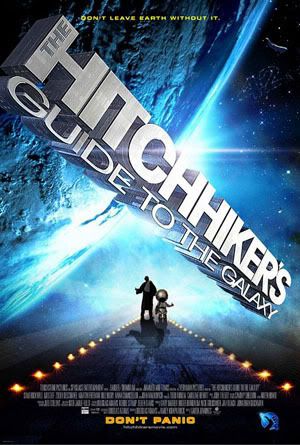
This is one reason the book is so well-suited for multiple readings-a high level of enjoyment is guaranteed each time around, and there are always new insights to be gained from Adams' underlying, oftentimes subtle, ideas and approach.
Adams' unique and peculiar sense of humor, rife with gonzo aliens, exploding galaxies, and the infamous Pan-Galactic Gargle Blaster, might not have found an audience at all had it not had the good fortune to burst upon the world during the hight of Star Wars mania. George Lucas's box-office demolishing opus had not only brought space opera into the mainstream of pop-culture consciousness, but for SF fans, it had brought some much needed light-heartedness into a genre that had been spending the past couple of decades taking itself very seriously indeed in an effort to rid itself of the stigma of juvenile pulp fiction and be regarded as mature literature.
Where Lucas, through the lamentations of the all-too-human droid C3P0 (of whom Marvin seems a loving parody) and the Mos Eisley cantina scene, had told SF fans it's perfectly okay to chuckle at this stuff now and again, Adams snatched the reins and propelled us into out-and-out farce. In fact it can be said that Douglas Adams probably made the first successful stab at comedy writing in SF in the last half of the 20th century. Sure, other writers had tried their hand at it, but no one really successfully made people guffaw until Adams came along with his inspired melding of Lucas and Monty Python.
The shenanigans began when Arthur Dent is grabbed from Earth by his friend Ford Prefect, whom he just found out is an alien, moments before a cosmic construction team demolishes the planet to build a freeway. They are aided by the Hitchhiker's Guide which offers such insights as "a towel is about the most massively useful thing an interstellar hitchhiker can have" and as well as galaxy of fellow travelers such as Zaphod Beeblebox, Vogons, and old and tired Slartibartgast.Given that, it still must be said that there's no point in trying to pretend this is any attempt at high literature, just as it's senseless to make an argument that the Three Stooges created timeless cinema. Hell, just kick up your heels and have a good laugh.
Much of the humor here is impossible to describe; this novel must be read to be appreciated. It seems like every single line holds a joke of some kind within it. The characters are also terrific: the unfortunate Arthur Dent, who basically has no idea what is going on; Ford Prefect, Arthur's remarkable friend from Betelgeuse; Zaphod Beeblebrox, with his two heads, three arms, and cavalier attitude; Trillian the lovely Earth girl who basically flies the Heart of Gold; Slartibartfast the planet builder and fjord-make extraordinaire; and my favorite character of all, Marvin the eternally depressed robot. Life-"loathe it or ignore it, you can't like it" is the Paranoid Android's philosophy.
One brilliant thing that Adams does is to step away from the action every so often to present interesting facts about the universe as recorded in the Hitchhiker's Guide; here we learn about Vogon poetry, the Ravenous Bugblatter Beast of Traal, Trans Galactic Gargle Blasters, and other fascinating tidbits about life in the crazy universe Adams created. He even gives the reader the ultimate answer to the question of Life, the Universe, and Everything in these pages.
This novel is just an amazingly hilarious read that will leave you yearning for more; to our great fortune, Adams indeed left us more in the form of four subsequent books in the Hitchhiker's "trilogy." If you don't like science fiction, it doesn't matter; read this book just for the laughs. The most amazing thing about Adams' humor is the fact that everyone seems to "get" it. Adams broke all the rules in writing a novel quite unlike any that had come before it, and he succeeded in spades. This may well be the funniest novel ever written.

-Jefferson
When it was written, 1984 stood as a warning against the dangerous probabilities of communism. And now today, after communism has crumbled with the Berlin Wall; 1984 has come back to tell us a tale of mass media, data mining, and their harrowing consequences.
It's 1984 in London, a city in the new überstate of Oceania, which contains what was once England, Western Europe and North America. Our hero, Winston Smith works in the Ministry of Truth altering documents that contradict current government statements and opinions. Winston begins to remember the past that he has worked so hard to destroy, and turns against The Party. Even Winston's quiet, practically undetectable form of anarchism is dangerous in a world filled with thought police and the omnipresent two-way telescreen. He fears his inevitable capture and punishment, but feels no compulsion to change his ways.
Winston's dismal observations about human nature are accompanied by the hope that good will triumph over evil; a hope that Orwell does not appear to share. The people of Oceania are in the process of stripping down the English language to its bones. Creating Newspeak, which Orwell uses only for examples and ideas which exist only in the novel. The integration of Newspeak into the conversation of the book. One of the new words created is doublethink, the act of believing that two conflicting realities exist. Such as when Winston sees a photograph of a non-person, but must reason that that person does not, nor ever has, existed.
The inspiration for Winston's work may have come from Russia. Where Stalin's right-hand man, Trotzky was erased from all tangible records after his dissention from the party. And the fear of telescreens harks back to the days when Stasi bugs were hooked to every bedpost, phone line and light bulb in Eastern Europe.
His reference to Hitler Youth, the Junior Spies, which trains children to keep an eye out for thought criminals- even if they are their parents; provides evidence for Orwell's continuing presence in pop culture. "Where men can't walk, or freely talk, And sons turn their fathers in." is a line from U2's 1993 song titled "The Wanderer".
Orwell assumes that we will pick up on these political allusions. But the average grade 11 student will probably only have a vague understanding of these due to lack of knowledge. It is even less likely that they will pick up on the universality of these happenings, like the fact that people still "disappear" without a trace every day in Latin America.
Overall, however, the book could not have been better written. Orwell has created characters and events that are scarily realistic. Winston's narration brings the reader inside his head, and sympathetic with the cause of the would-be-rebels. There are no clear answers in the book, and it's often the reader who has to decide what to believe. But despite a slightly unresolved plot, the book serves its purpose. Orwell wrote this book to raise questions; and the sort of questions he raised have no easy answer. This aspect can make the novel somewhat of a disappointment for someone in search of a light read. But anyone prepared to not just read, but think about a novel, will get a lot out of 1984.
1984, is not a novel for the faint of heart, it is a gruesome, saddening portrait of humanity, with it's pitfalls garishly highlighted. Its historic importance has never been underestimated; and it's reemergence as a political warning for the 21st century makes it deserving of a second look. Winston's world of paranoia and inconsistent realities is an eloquently worded account of a future we thought we buried in our past; but in truth may be waiting just around the corner.
Scout and her older brother are children growing up in the backyards and fields of small-town Alabama in the 1930s. When the book opens, Scout is about to go to school for the first time. Their father, Atticus Finch, is a esteemed lawyer and Congressional repesentative for the region. Their mother died when Scout was two, and Atticus has raised them with the help of a black nurse (who also serves as cook). Atticus is about to take on, at the request of the court, a case of a black man accused of raping a white woman, a case that will stress the town and the Finch family and uncover both the prejudice and the dignity of the people of Maycomb.
Despite being Harper Lee's first novel, it's widely considered among the greatest and is frequently assigned in school. I missed many of the classics in high school including this one and have been going back to see what I missed, so it's my first exposure to the book. It's pervasive enough, though, that I had picked up a mental connection between the name Atticus and great lawyers without knowing where that was from.
My expectation going in was that this would be a coming of age story of sorts about the culture of the South. It is that to a degree. The first section of the book settles into that pattern, telling of childish exploits, summers of freedom, town legends, loved and hated relatives, and confrontations with the class structure of Maycomb in school. Even this section, however, is one of those stories where a brief outline of the plot makes the book seem less appealing than it is. Lee has both a fine eye for characterization and pacing and a deft touch with dialect. Coming of age stories, particularly of childish pranks and dares, usually leave me cold, but the characters are so vivid and deep and the relationship between Scout and her father so touching that I didn't mind the plot. The story is written somewhat in the dialect of the region, but Lee uses this just enough to give the account flavor and not so much that I had difficulty following it. I had to guess at terms in a few places, but the reading experience is smooth.
This first section is not the heart of the book; it's only background and character and cultural introduction. Soon, Atticus is drawn into the trial, the children start taking insults because their father is defending a black man, and the tension rises markedly. The lines of class and race that have been in the story from the beginning become more pronounced, and Atticus's quiet insistence on the basic worth of human beings becomes more relevant and poignant. The climax, about two-thirds through the book, of the trial is one of the most engrossing and emotionally affecting pieces of literature I've ever read.
This is not a triumphant book, nor is it an angry one. It's a story about seeing people as people and trying to understand them, about taking small changes where they can be had, about being decent and behaving honorably. It deals with difficult attitudes that don't change easily or overnight. Deeper than that, it's a book about accepting the good in people and trying to help them deal with the evil. Lee presents a memorable picture of a father trying both to raise idealistic children and children who can live in the world that is, who is trying to do the right thing even when the right outcome isn't possible. Despite all the reason for pessimism, it's a book that helps one appreciate people and provides reason for hope.
The end of the book ties back to one of the subplots of the beginning and follows the return of the town to something approaching normalcy. It's a bit of a letdown after the emotional drama of the trial; there is continuing dramatic tension, but it's more personal, closer to home, and doesn't feel as significant. Stay with it, though, as Lee is going somewhere with the conclusion. In the last few pages, she ties together the desire for action, the outsider perspective, the flaws and fallout of any human action, and the inherent dignity of humanity in scenes that, if quieter and less grand than the courtroom, have nearly as much depth.
Reading a lot of science fiction has left me sensitive to techniques of alienation in literature. Lee uses them effectively here, at least for a reader separated by culture and time from her setting. Scout is deep within the culture of the book and simply takes it for granted, but she's a child, and Lee uses explanations from adults as explanations to the reader. To Kill a Mockingbird dares the reader to react, both to Scout and with her, as the politics of the town are slowly revealed. If anything, I think the book is more effective fifty years later when no one speaks of blacks even the way that Atticus does (but with racism still present, just unspoken). The modern reader has an ingrained and immediate dislike of the racists that Lee plays off of and against, both using it to increase our sympathy for Atticus and to make the reader go back and reconsider impressions of people who seemed vile on first glance. This book left me with a strong sense of the slow moral arc of the universe described by Martin Luther King, Jr. — an appreciation for small gains, the slow pace at which people are able to change, and the dignity of trying.
Classics have a bad reputation partly they're so often assigned reading (not the best circumstance under which to meet a book), and stories of the small-town South never sounded that appealing to me. If you've been avoiding this book out of fear that it was literary without being entertaining, don't. The plot may not sound that appealing, but the characterization is exceptional and the dramatic payoff is one of the best I've read. Regardless of any deeper moral point, this is simply good storytelling and deserves to be as famous as it is.

"You will never be happy if you continue to search for what happiness consists of. You will never live if you are looking for the meaning of life"
- Albert Camus
For Camus, life has no rational meaning or order. We have trouble dealing with this notion and continually struggle to find rational structure and meaning in our lives. This struggle to find meaning where none exists is what Camus calls, the absurd. So strong is our desire for meaning that we dismiss out of hand the idea that there is none to be found.
What sets Camus apart from many existentialists and modern philosophers in general is his acceptance of contradiction. Yes, Camus wrote, life is absurd and death renders life meaningless--for the individual. But mankind and its societies are larger than any one individual person.
Camus wrote The Stranger as an enticement to his readers, to think about their own mortality and the meaning of their existence. The hero, or anti-hero, of The Stranger is Meursault. His life and attitudes possess no rational order. His actions are strange to us, there seems to be no reason behind them. We are given no reason why he chooses to marry Marie or gun down an Arab. For this, he is a stranger amongst us. And when confronted with the absurdity of the stranger's life society reacts by imposing meaning on the stranger.
It's worth noting here that The Stranger is sometimes translated as The Outsider but this is inaccurate. Camus does not want us to think of Meursault as ‘the stranger who lives ‘outside' of his society' but of a man who is ‘the stranger within his society'. Had Meursault been some kind of outsider, a foreigner, then quite probably his acts would have been accepted as irrational evil. But Meursault was not an outsider; he was a member of his society – a society that wants meaning behind action.
In the second half of The Stranger, Camus depicts society's attempt to manufacture meaning behind Meursault's actions. The trial is absurd in that the judge, prosecutors, lawyers and jury try to find meaning where none is to be found. Everyone, except Meursault, has there own ‘reason' why Meursault shot the Arab but none of them are, or can be, correct. In life there are never shortages of opinion as to why this or that thing occurred. How close to any of them get to the meaning behind action?
An interesting motif in The Stranger is that of watching or observation. Camus is writing a book about our endless search for meaning. We are all looking for a purpose in our lives. The characters of The Stranger all watch each other and the world around them. Meursault watches the world go by from his balcony. He later passively watches his own trial. The world around him is a fascination to Meursault. He keenly observes the sun, the heat, the physical geography of his surrounding. The eyes of the other are also depicted by Camus. Antagonism behind the eyes of the Arabs, as they watch Meursault and his friends. The eyes of the jury and witnesses at his trial. Finally the idea of the watching crowd, representing the eyes of society.
The Stranger is not so much a story but a statement by Albert Camus. Meursault, the main character attends his mother's funeral and does not apply the emotions one would associate with a funeral; he does not cry and when offered a cup of white coffee he drinks it and enjoys drinking it, these mannerisms are not those suspected of a grieving man but he does not act like this in deliberance, it is just his manner. However because he does not, in the author's words 'play the game' people in society judge him as a strange and heartless man which at the end of the book costs an honest man his life.
Needless to say, this is not an uplifting book, but it is an engaging, thought-provoking one. While Camus cannot be called a true existentialist in his own philosophical outlook, his fiction does epitomize many existentialist ideas. Marsault is a protagonist like no other in literature--you cannot like him, he is obviously guilty of killing a man in cold blood, and he is of a cold-hearted nature, yet you do understand some of his thinking, find yourself more and more interested in his dark outlook on life, and have to admit that much of what he believes makes sense.

"A human doesn't have a heart like mine. The human heart is a line, whereas my own is a circle, and I have the endless ability to be in the right place at the right time. The consequence of this is that I'm always finding humans at their best and worst. I see their ugly and their beauty, and I wonder how the same thing can be both."
So muses the narrator of Markus Zusak's powerful and moving new novel, The Book Thief. As you might guess, this is no ordinary narrator. The contemplative first person guiding you through this book is Death, an at-once fitting and ironic vanguard for a tale that both celebrates the power of words and agonizes over the consequences of their use.
Set against the tragedy-stained canvas of World War II, Death tells the story of young Liesel Meminger (the eponymous book thief) growing up in Nazi Germany under the watchful eye of a staunch foster mother and kindly foster father who teaches her to read. She attends meetings of the BDM, a youth group aimed at indoctrinating young girls into Hitler's ideology. She plays soccer with the boys on her street, holding her own in any disputes that arise. And all the while, the dreams of her dead brother haunt and goad her into a fascination with reading and words that inevitably leads to her life of crime.
It is a meeting with Max Vandenburg, a 24-year-old Jewish man being hidden in Liesel's basement by her compassionate foster parents, that alters the course of Liesel's life. Max, too, is haunted by nightmares of a family he lost in the harrowing aftermath of Kristallnacht. Together, Max and Liesel discover a shared love of words that leads to a decisive understanding about the role words play in both bravery and cowardice. Each, in their own way, sets out to use this knowledge to shape the world around them.
While other writers have employed Death as a narrator, Zusak makes his own indelible mark on the technique in the dimensions he gives to the character. Death is simultaneously dispassionate about his work and the impact it can have while striving to understand humanity's resilience. Death boasts an omniscience of what will happen in life but also a naivety about what can happen in the human heart.
Sometimes a fictional interpretation of history is exactly what we need in order to be able to come to a real understanding of what it meant to live through historic events, particularly horrific ones. Markus Zusak provides us with a masterful interpretation of the Nazi period of German history from the perspective of ordinary people suffering through it and striving to keep their lives together and their souls alive and kicking within the horrific and ever-tightening boundaries constructed by the Nazi regime.
He gives us a gut-wrenchingly palpable empathy for people facing harrowing decisions on a daily basis. His marvelous characters bring to life the dilemmas of those who believe they should help the Jews as well as the equally nightmarish predicament of Jews who through receiving help put others in danger. We see much of this through the perspective of the main character Liesel, who is only a young girl. Her innocence and the gradual realizations she comes to about the events swirling around her in a maelstrom of horror evoke a remarkable empathy in the reader.
In the ultimate expression of his dichotomous theme, Zusak creates a touching love letter to books and writing, framed in arguably the most horrific period in human history. But his greatest triumph is delivering a reminder that no writer enters this world quietly. Writers are born of eruptions and detonations, and the truly exceptional ones, like Zusak, continue to channel these explosive energies to craft a truly remarkable book that will be admired for generations.
If you want to understand how the little people cope with such tragic historic events without allowing their souls to be crushed, read this book. Ultimately it is a portrait of the resilience and hope of the human spirit.

Written by Orson Scott Card, Ender's Game is a novel of extraordinary power that is among the very best the genre has ever produced. Lauded with both the Hugo and Nebula awards, it tells the story of genius child Andrew "Ender" Wiggin who is reared to be the military savior of humanity. At the tender age of six, he is whisked off to battle school where warfighters tutor him in the lonely job of commanding Earth's fleet against the alien "buggers" who twice attacked earth.
The novel follows Ender as he navigates the puzzling, cruel and unfair world created by the Battle School teachers and the other children to complete his military training and assume the responsibility he has been shaped for, by learning to out-bully his enemies, outsmart his teachers, and think like the aliens he is being raised to kill.
Ender's Game takes a familiar theme from war fiction — war as seen through the eyes of a child, and reframes it by making the child the war's central figure. It is a tale defined by a sense of both tragic inevitability and cold irony. It is not merely about the loss of innocence, as so many stories are with children at their center. It is about innocence systematically deceived and purposefully destroyed in the fanatical pursuit of a misguided higher ideal.
Ender’s Game is science fiction with a tough, enjoyable core of psychology and ethical dilemmas. The most intriguing aspect of this novel is not the clichéd concept - brilliant child is selected by authority figures and grows up to save the world - but the startling tweaks in that concept and the details through which Orson Scott Card presents Ender’s isolation, his inner turmoil, and the extremes to which a young boy is forced in the name of what is “good.”
A hardcore sci-fi war and gravity-free mock training battles will appeal to some readers, and the psychological dilemmas and mental puzzles will appeal to others. However, it is Ender’s personal journey, and that of his siblings back on Earth and his cohort of other Battle School students, that will fascinate readers whether or not they are fans of science fiction.
Ender's Game works from its first page to its last. For one thing, it's the character study of a young boy whose childhood is being denied him by those who are in fact putting on a show of catering to it. The battle games are just that, games, but the consequences are real in terms of how they effect real lives. Ender's flawless leadership record — his gift for unconventional thinking means he never once loses, even when the odds are absurdly stacked against him and his platoon — earns him enemies among lesser, jealous commanders, and an actual attempt on his life is made. When Ender successfully defends himself against one (using the same skills at thinking on his feet that have made him victorious in the Battle Room), the blinders come off. This world of children's games is in fact one that deals in the grim realities of life and death.
But are the blinders off all the way? The I.F. is clear about their agenda: fight the buggers. What they aren't clear about are their methods. The more Ender advances, the more it becomes clear the Battle School's games have no rules at all, or none that can't be changed completely. Ender's Game examines the ethics of power and the role sheer manipulation can play in forming the cultural and political landscape people live in. Both in the Battle School, and in an interesting subplot where Ender's siblings Peter and Valentine (both of whom are as much prodigies as he is in their own way) compose for their own amusement pseudonymous political essays on the web that end up having more influence worldwide than they could've dreamed of, Card explores how easily and unwittingly people can find themselves played. And even when you are aware of it, how difficult it can be to do anything about it. And this all comes to a head in the book's sucker-punch of a climax.
Ender's Game is no didactic anti-war tract. It wouldn't be, really, as Card is a proud conservative. If the book has any message to deliver about war, it does so through the time-honored tradition of fine storytelling, and it's this: It's no game.
"I learned so much about some stuff that I ended up not knowing anything at all about it”.
This quote (from the end of King Dork) serves as a metaphor for the book itself; an amusing albeit convoluted tale of teen America. The novel, although widely hailed as a success, often gets bogged down in the protagonist’s neurotic manner. It is largely, however, an accessible and enjoyable piece of writing; showing American teen life through the eyes of the underdog. Portman, in an impressive debut, creates a refreshing and cynical glimpse of the American High School system; a funny yet important novel that ultimately will make you laugh.

Tom Henderson is not having a good time. His high school is a dump, failing to teach him anything but scathing contempt for his peers and the mispronunciation of what is referred to as ‘extended vocabulary’; bullies great and small take pleasure in persecuting him; his mother is insane, his sister strange, his stepfather Little Big Tom (for reasons of differentiation) is a harmony-addict hippie. He can’t seem to manage to land himself a girlfriend, his only friend Sam Hellerman became his ally solely because they are related for alphabetical reasons and spend a lot of time standing in line next to each other. Above all, nobody quite gets young Tom’s view of the world. I repeat, Tom Henderson is not having a good time, at all.
Although things may not take a turn for the better, they certainly take a turn for the more exciting when Tom, a) meets a mysterious girl at a lame-o party and, b) finds a collection of his deceased father’s books, including Tom’s least favorite book ever Catcher in the Rye, which reveal a laundry receipt and ancient note even more mysterious than the girl from the lame-o party. It is time for King Dork to turn Sherlock Dork.
King Dork is by no means a story that has never been told before. Messages from beyond the grave aside, this is a coming-of-age story, following the grand tradition of Adrian Mole and his brothers-in-arms. Stacked with contemplations on sex, epiphanies about yourself and your family, and passionate complaining about how incredibly inept everybody is, King Dork is the epitomy of teen angst and the horrors of high school.
Singer/songwriter/guitarist-turned-writer Frank Portman could have done himself some serious harm with this (his first) book. A first novel about a troubled teenage boy is hardly an outstanding achievement in terms of originality, even if your band has a cool name like ‘The Mister T. Experience’. However, Portman endows Tom Henderson with a voice that sets him apart from his fellow whining teens in peril. The ‘extended vocabulary’ classes at his ridiculous high school really pay off for Tom. Steering clear of using words like ‘like’ and ‘whatever’ twenty times in every sentence is a good start to keep young adult fiction from turning into mind-numblingly dull Valley-Girl rants. It also lends fair credibility to Tom’s sarcasm regarding pretty much everything.
It seems curious that a guy who’s been playing in pop-punk bands for almost 30 years has suddenly become a well-regarded author of “young adult” literature. But it’s not so surprising when you consider that Portman’s songs generally deal in themes befitting the high school set: girls, break-ups, ironic sarcasm, girls, rock bands, girls, dates, nerd humor, and of course girls. All perfectly suited to the heightened emotional spazzfest of adolescence. But where most mid-40s pop-punkers singing about teenage experiences come off as brain-dead, Portman writes and sings about them with wit, insight, and the kind of vocabulary you’d expect from a UC Berkeley graduate. He’s no dummy, he just happens to have spent most of his life writing power-chord rock songs about not being able to get a girlfriend.
And that’s exactly where King Dork comes in. The book takes Portman’s skills at examining the angst and trials of “young adulthood” through irony and wit, but expands the tableau from 3-minute songs to a 350-page novel. And it works incredibly well. I found myself reading it quickly but being thoroughly entertained; I was intrigued by the main character’s inner dialogue and also laughed out loud at a lot of the humor. Though the book is intended for “young adults” it’s an entertaining read at any age, and since we’re all clutching our Harry Potter volumes right now anyway we’re obviously in the mood for well-written fiction that might seem a bit beneath our true ages (though I admit I haven’t read any HP books).
Actually, an important aspect of the book is the way Tom (and obviously Portman) feels about The Catcher in the Rye, that book we were all forced to read a dozen times because it changed our teachers’ lives. I think this is best summed up in a quote:
It’s kind of like a cult. They live for making you read it. When you do read it you can feel them all standing behind you in a semicircle wearing black robes with hoods, holding candles. They’re chanting “Holden, Holden, Holden…” And they’re looking over your shoulder with these expectant smiles, wishing they were the ones discovering the earth-shattering joys of The Catcher in the Rye for the very first time.
Tom refers to this secret society as the Catcher Cult, and the though King Dork obviously has roots in Catcher’s portrayal of teen angst, it harbors a distinct grudge against the book. I mean, just look at the cover: a deliberate defacement of the old maroon paperback from the bargain bin. But Catcher isn’t the only standard from the sophomore summer reading list that gets the Portman analysis, and some of them are actually looked on quite favorably.
My favorite aspects of King Dork come from Portman’s method of describing the day-to-day dynamics of high school. Now, this is stuff we’ve not only experienced but seen satirized in hundreds of teen comedies over the years. But King Dork puts a fresh spin on it via Portman’s distinct brand of sarcasm. Remember, he’s been writing humorously ironic songs about adolescent frustrations for going on 30 years. I laughed out loud at his description of the “Make out-Fake out” deception used by teen girls to mess with the guys’ heads, and when Tom learns new vocabulary words such as callipygous and ramone (from the French ramoner, to scrub out a chimney…combine with Tom’s rock & roll background and you have a perfect new neologism for intercourse). The book’s action culminates in a performance by Tom and Sam’s band at the battle of the bands, which of course has been renamed the Festival of Lights by the school’s P.C.-police due to the negative connotations of the word battle and the fact that bands is unfairly exclusive to some students.
Needless to say, King Dork gets my major thumbs up. I don’t have the opportunity to read for pleasure very often, so I’m very glad this book came across my path when it did. Portman is currently working on a second novel, and he’s said that he might eventually write a King Dork sequel. Though it’s tacky to quote a review from the book’s dust jacket, I feel this one pretty much sums up how I felt after reading it:
"This book is for you if you’re in a band or wish you were, if you loved or hated The Catcher in the Rye, if you like girls or are one, if you’ve ever spoken Français or Franglais, or if your high school has or had a dumb mascot. Basically, if you are a human being with even a vague grasp of the English language, King Dork will rock your world."
First and foremost, on my halcyon days of youth, this is the beloved book that open my immutable eyes in the ecstatic pleasure of reading. I kept thumbing through the pages with bated breach, committing myself to the memory and imprinting the events on my head. No other book can ever take its place.
There are few masterpieces in classic English literature that are way out wacky, seemingly shallow, funnily defiant and yet emerge as ground-breaking in terms of their impact all the same. J. D Salinger’s Catcher in the Rye is one such terrific book.

The book is amongst the first of its kind and time, presenting no rollicking plot or lyrical language to convey its message. Straightforward in a bewildering way, the author makes this a laughing riot that nudges streams of edgy resonance and earnest reflection.
Holden Caulfield is the sixteen year old endearing but possibly debatable narrator, who finds everything phony, is politically incorrect, is generally bored, swears at the blink of the eye and mostly comes through as a plain pest! - “Grand. There’s a word I really hate. It’s phony. I could puke every time I hear it.” Yes, dear Holden is like that!
Growing up is difficult for teenagers who are as confused as Holden Caulfield. Assuming that the adult world is full of pain and disappointment, Holden protects himself through isolation. Although he isolates himself he still craves the warmth of another person. This novel gives the reader a glimpse into Holden's life through his point-of-view. J.D. Salinger, the author, wrote this novel around the 1950s. The Catcher in the Rye illuminates an adolescence's struggle to find his identity while he is stuck between adulthood and the sweet innocence of childhood.The book exclusively traces the life and thought process of Caulfield, from the moment he is expelled from prep school, while he roams around directionless in the streets of New York, alienated and revolted by most things human - until he reaches home, all in the span of only a few days. In the course of this time, Holden has a dry night clubbing, a bizarre experience with a prostitute, a lousy meeting with Mr Antolini, and a moving moment with innocent and charming Phoebe, his younger sister; Holden being excessively judgmental, hilariously pessimistic, and hopelessly resigned through out.
While many of us while reading could dismiss him as a bundle of teenage mess and maladjustment, perceiving everything as meaningless, flawed and phony, what Holden really searches for is a world of genuineness and integrity - where the natural is not smashed by societal expectations; hopelessly seeking a perfection of an unearthly standard in a place that is engulfed in pretense, ostentation and foppery - Holden is an intolerable dissident, in a world he just doesn’t want to fit into.
The sole spark in Holden’s desperate life manifests in his heart-warming meet with Phoebe, his bright and instinctive little sister, giving us a peek into the few things Holden really loves and values, beautifully divulging Holden’s fond and tender love for his family. Holden often evokes emotive soliloquies with his late brother Allie, and comes to spend nostalgic moments with Phoebe who personifies the naturalness and purity that Holden wishes to save forever. She so simply is pretty much the one who puts things into perspective for him. It is here when Holden tells Phoebe, that what he really wants to be- is the “The Catcher in the Rye”, as he pictures thousands of children playing untroubled and carefree in a field of rye while he stands guarding them on the edge of a cliff, only to save their untouched spirit if they start to go over it - from a world of incorruptibility, innocence and freedom, to a world he perceives as stunting, fake and typical.
J. D Salinger’s Holden Caulfield is obnoxious and lovable, pleasing and distressing, offensive and righteous. His narrative and reflections are penned down as side-splitting is most parts, literally making you laugh out loud, but his intentions and expectations are solemn and noble - to say the least. This book of Salinger’s is one amongst the most popular in literature, but it takes one who is truly free-spirited, open and unorthodox to appreciate it in entirety.