
It's almost become a personal joke that every time a new Will Ferrell movie comes out, I want to see it but have nothing to say afterwards. I'm not quite sure exactly why this is; I think he's a brilliant comedian, and most of the movies he's made since he became an A-lister have been consistently good. But one supposes that in the world of comedy, you really don't want to know much more than whether or not it's worth watching; spoiling the set-ups (much less the punchlines) kind of ruins the experience for readers, unless you have some  deep or profound insights about them.
I like Will Ferrell. He makes me laugh. Lots. It's rare that I don't laugh lots when I watch a Will Ferrell movie, save for Stranger Than Fiction, which can bite me. Talledega Night? Lots of laughing. Anchorman? Uhuh. And now there's this movie. I laughed at it. Lots.
Blades of Glory is very funny, and the humor is what you'd expect from Ferrell's comedies. Did you like those other films I listed in the paragraph above? Then you're probably going to like this one. The jokes are sophomoric, but funny and occasionally hyper-bizarre, e.g. the final scene. Gross-out humor and simple parodies, which sometimes seem to be overtaking the comedy genre in Hollywood, are largely missing, save for a surprise decapitation scene. That by the way, I laughed at huge.
Though there aren't as many gut-busting laughs as I expected, Blades is in the "sports underdog" tradition, with a strong enough story to carry the movie in between jokes. There are plenty of laughs; they just come more from character interaction and the inherent absurdities of competitive figure skating's pomp and circumstance than from typical Will Ferrell gags.
Looking at this cast, even if the writing had been cribbed straight from a treatise on post-modern interpretations of Biblical dispensationalism, there's a strong likelihood this movie would have still been funny. Ferrell, Heder, Arnett, Poehler, and Jenna Fischer—an All-Star lineup and each are on their game. Heder in particular shone, changing up his usual slack-jawed comic presentation, to a straight set-up man, a fine complement to his co-star's Alpha Male routine. Arnett and Poehler (married as they are) delivered, and any time an Arrested Development alum gets work is fine by me. Jenna Fischer is, of course, awesome, so need to go into much 
No matter how good the actors are, Blades of Glory would have fallen flat if they'd gotten the figure skating wrong. Fortunately, they got it right. Oh, so right. It's astonishing no one's made a comedy about figure skating before. I can't think of another sport with as much built-in comedy.
FAMOUS LAST WORDS
In this era of political correctness, it would be easy to take offense to this movie's central comedic premise: that seeing two guys in spandex embracing, twirling, and lifting each other is funny. However, for a film whose main joke relies on the "ickiness" of one man touching another, it certainly celebrates the journey Michaels and MacElroy take in overcoming their hatred and hang-ups—finally giving themselves over to the intimacy of pairs skating. As a metaphor for becoming comfortable in your own skin, nothing quite beats spandex. Blades of Glory is, at heart, a buddy movie—a buddy movie where one buddy hoists the other buddy up in the air by the crotch. What can I say? That's figure skating.
Anyway, to sum up: Blades of Glory = funny.
These suckas are as cool as ice.
It's pleasing to see that Square Enix — despite having the Final Fantasy, Dragon Quest, and Kingdom Hearts mega franchises in its line-up — is still willing to go boldly into new frontiers with the release of original g
At first glance, the game seems little more than a pastiche of all the things that have made the famed Japanese developer's RPGs massive successes in the past. Angsty teen hero with an absurdly angular haircut? Check. Complex, team-based combat system? You betcha. Detailed customization options with weapons and armor that border on the anal retentive? Fer sure. But The World Ends With You merely uses these Square Enix conventions as a launching pad for a unique experience that is both impressive in its use of the Nintendo DS's capabilities and compelling in its storytelling.
The most apparent difference from previous Square Enix games is location. The World Ends With You is set not in an imaginary kingdom, but entirely within Tokyo's fashion and shopping hub, Shibuya. Several real-world landmarks from Shibuya are re-created within the game, such as the train station, Shibuya Crossing, Hachiko's statue, Dogenzaka, and more. However, this shift to a modern setting isn't mere window dressing, given that it greatly complements the game's overall design. Developer Jupiter Corp has stuck to a character look s
The story itself is a little like The Matrix, and a little like Battle Royale. The game follows main character Neku Sakabara as he's forced to play The Reapers' Game, a sinister competition in which the (mostly) evil Reapers assign players, like Neku, a task every day for seven days. Fail to complete the task within the set time limit and the player is completely erased from existence. Strangely, none of the other inhabitants of busy Shibuya can see Neku or the other players, although a mysterious pin that Neku finds on his person when he first wakes up in Shibuya lets him read people's minds. What's even more disconcerting are the large groups of strange creatures now roaming the streets. Although normal people can't see these creatures — called the Noise — they can see Neku, and they're out for blood. Along the way, Neku is forced to make pacts with other characters because forming these bonds and fighting in pairs is the only way to do damage to the Noise.
There are some genuine twists in this game's intriguing story, and there is also plenty of heartfelt emotion from its teenage protagonists, which makes for some truly touching moments. The themes explored here — finding your identity, overcoming insecurity, teen angst, coping with guilt, the weight of obligation — are nothing new for a Square Enix game, but they seem somewhat more resonant and identifiable because they're coming from characters who use mobile phones, eat fast food, and who do other things that ground them in the same world we live in.
Traversing the world of Shibuya is done through the stylus and touchscreen, but battles are where it gets more complex. The game's setting might be somewhat of a departure for a Square Enix game, but the comba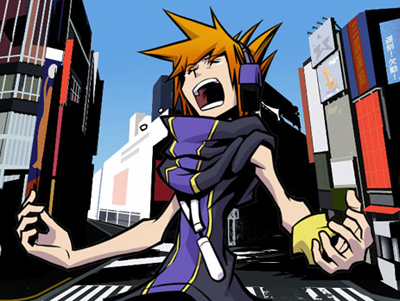
The presentation of The World Ends With You impresses right from the game's beginning. Graphically, the game just sparkles, and its stylized version of Shibuya pops with color and detail. Large, colorful character models w
Flawless presentation, gameplay depth, an engaging story, and innovation all add up to make The World Ends With You a worthy addition to the already-impressive pantheon of Square Enix works. There's very little to complain about in this package, which makes The World Ends With You a must-have for any DS owner needing an RPG fix.
Despite a few stumbles, this is one world I don't want to end.