
There's very little here that's left to chance here. In less than four minutes, they establish who this character is and leave him dangling on the edge of death. Over the next 30 minutes, we learn Stark is whip smart, has the resources to do whatever he wants, and most of all has the passion and determination to pull it all off, no matter the cost. Now imagine that power in the hands of someone whose 
Bringing Iron Man to the big screen must have been tough. Sure, the high-tech armor and all the explosions are no-brainers, but the character behind the armor is tougher to pin down. Superman and Spider-Man are likable every man, Batman is a brooding (and therefore cool) loner, and the Hulk and the X-Men are sympathetic, misunderstood monsters. But Tony Stark? He's an obnoxious bastard. He rubs people the wrong way, he makes bad decisions, and he often puts his own needs and wants above others. If you were to meet him, you'd probably think, "What a rich jerk."
So how do you make this guy a hero for audiences to root for? One option would have been to toss out the character as originally written and go in some other direction. Another option would to have made his change of heart—so to speak—in the movie a "night and day" juxtaposition, where's he's only a jerkwad before he becomes Iron Man, and then he's a newly stalwart Tony afterward. Favreau and the screenwriters, however, take the path less traveled, by sticking with an unlikable protagonist throughout. Sure, Tony sees life in a new light after his Afghanistan escape, and he's newly devoted to doing the right thing, but he's still Tony. He still loves the parties and the hot cars, and he still doesn't give a damn what anyone else thinks of him. Funny thing about unlikable protagonists—when written well, we do end up liking them in a way, simply because they're fascinating characters.
Shouldering the burden of this performance—and the entire film, really—is Robert Downey Jr. Some have said that Downey Jr. is merely playing himself in the movie, and others have drawn parallels between the actor and the fictional character. I won't disagree, but if that's wha
For as well-made and fun as this movie is, it made some serious narrative missteps during its climax, just slightly tainting the enjoyment of the overall film. As noted above, the finale does offer some action, but it's not really the big, larger-than-life set piece the movie needs at this point. The finale starts with Iron Man not at full strength, with his suit's automated system already telling him he's losing power. Wouldn't it have been more exciting to Iron Man cut loose with all his firepower, instead of being in a weakened state for the whole fight?
Even worse, it's here that the movie falls into cheesy superhero clichés, giving Paltrow embarrassing lines like "He's gone insane!" and "But you'll dieeee!!!" Likewise, Stane has an awkward line about his targeting system, which will give all the Star Wars haters nightmare flashbacks to that whole "I've got the high ground" thing. With all the careful thought and planning that went into this 
The world needs another comic book movie like it needs another Bush administration, but if we must have one more (and the Evil Marketing Geniuses at Marvel MegaIndustries will do their utmost to ensure that we always will), Iron Man is a swell one to have. Not only is it a good comic book movie (smart and stupid, stirring and silly, intimate and spectacular), it's winning enough to engage even those who've never cared much for comic books or the movies they spawn.
Crash tells interlocking stories of whites, blacks, Latinos, Koreans, Iranians, cops and criminals, the rich and the poor, the powerful and powerless, all defined in one way or another by racism. All are victims of it, and all are guilty it. Sometimes, yes, they rise above it, although it is never that simple. 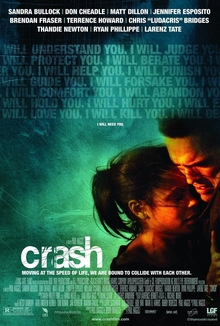
The result is a movie of intense fascination; we understand quickly enough who the characters are and what their lives are like, but we have no idea how they will behave, because so much depends on accident. Most movies enact rituals; we know the form and watch for variations. Crash is a movie with free will, and anything can happen. Because we care about the characters, the movie is uncanny in its ability to rope us in and get us involved.
Crash was directed by Paul Haggis, whose screenplay for Million Dollar Baby led to Academy Awards. It connects stories based on coincidence, serendipity, and luck, as the lives of the characters crash against one another other like pinballs. The movie presumes that most people feel prejudice and resentment against members of other groups, and observes the consequences of those feelings.
One thing that happens, again and again, is that peoples' assumptions prevent them from seeing the actual person standing before them. An Iranian is thought to be an Arab, although Iranians are Persian. Both the Iranian and the white wife of the district attorney believe a Mexican-American locksmith is a gang member and a crook, but he is a family man.
A black cop is having an affair with his Latina partner, but never gets it straight which country she's from. A cop thinks a light-skinned black woman is white. When a white producer tells a black TV director that a black character "doesn't sound black enough," it never occu
You see how it goes. Along the way, these people say exactly what they are thinking, without the filters of political correctness. The district attorney's wife is so frightened by a street encounter that she has the locks changed, then assumes the locksmith will be back with his "homies" to attack them. The white cop can't get medical care for his dying father, and accuses a black woman at his HMO with taking advantage of preferential racial treatment. The Iranian can't understand what the locksmith is trying to tell him, freaks out, and buys a gun to protect himself. The gun dealer and the Iranian get into a shouting match.
I make this sound almost like episodic TV, but Haggis writes with such directness and such a good ear for everyday speech that the characters seem real and plausible after only a few words. His cast is uniformly strong; the actors sidestep cliches and make their characters particular.
For me, the strongest performance is by Matt Dillon, as the racist cop in anguish over his father. He makes an unnecessary traffic stop when he thinks he sees the black TV director and his light-skinned wife doing something they really shouldn't be doing at the same time they're driving. True enough, but h
That traffic stop shows Dillon's cop as vile and hateful. But later we see him trying to care for his sick father, and we understand why he explodes at the HMO worker (whose race is only an excuse for his anger). He victimizes others by exercising his power, and is impotent when it comes to helping his father. Then the plot turns ironically on itself, and both of the cops find themselves, in very different ways, saving the lives of the very same TV director and his wife. Is this just manipulative storytelling? It didn't feel that way to me, because it serves a deeper purpose than mere irony: Haggis is telling parables, in which the characters learn the lessons they have earned by their behavior.
Other cross-cutting Los Angeles stories come to mind, but Crash finds a way of its own. It shows the way we all leap to conclusions based on race -- yes, all of us, of all races, and however fair-minded we may try to be -- and we pay a price for that. If there is hope in the story, it comes because as the characters crash into one another, they learn things, mostly about themselves. Almost all of them are still alive at the end, and are better people be
Not many films have the possibility of making their audiences better people. I don't expect Crash to work any miracles, but I believe anyone seeing it is likely to be moved to have a little more sympathy for people not like themselves. The movie contains hurt, coldness and cruelty, but is it without hope? Not at all. Stand back and consider. All of these people, superficially so different, share the city and learn that they share similar fears and hopes. Until several hundred years ago, most people everywhere on earth never saw anybody who didn't look like them. They were not racist because, as far as they knew, there was only one race. You may have to look hard to see it, but Crash is a film about progress.