
Another irresistibly goofy bit of fluff in Terry Pratchett's staggeringly popular Discworld series, Mort tells the tale of the title youth, a rather simple young man who is hired as an apprentice one evening by none other the ever-popular Death. At first, poor Mort finds himself ingloriously mucking out the Reaper's stables. But soon the boy is accompanying Death on his soul-gathering rounds, and not long after is actually taking Death's own horse (Binky) out and filling in for the old Reaper himself.
But when Mort, out of love and chivalry, prevents the scheduled demise of a pretty teenage princess, his actions cause a rift in the course of history from that point on, causing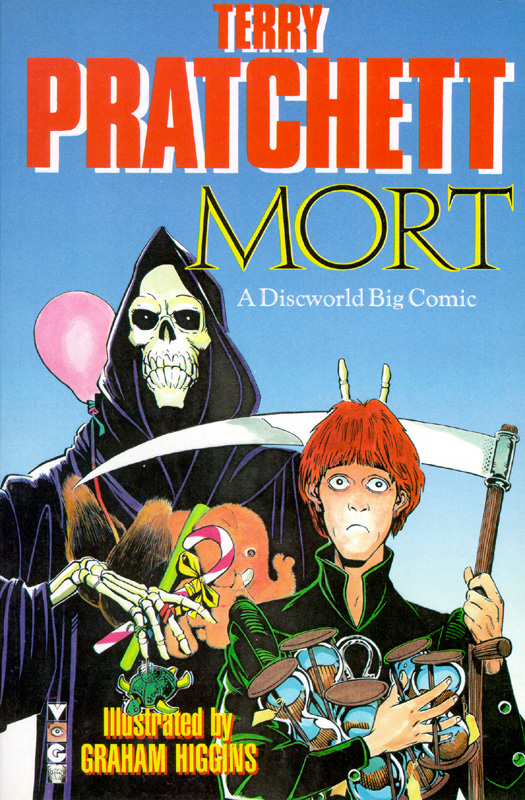
Yes, it is all rather silly for much of its length, and on first blush it seems to have all the substance of a bouquet of party balloons. But if there's one thing you can say about Terry Pratchett, it's that beneath the gags there's a really warm and endearing outlook on life, death, and the need to cherish the time we have before that time is, inescapably, up. While some of Pratchett's jokes are a tad too self-conscious (you can practically hear the laugh track accompanying them), quite often he's a droll fellow. The tales he spins are inventive, whimsical, and fun to read. Mort, after a shaky start with too many sarcastic dialogue exchanges and trite bits of slapstick including Death spoiling his air of ominousness by slipping on a patch of ice and that sort of thing, really begins to take off when the fantasy elements of the tale take precedence, and the humor starts to serve the story rather than vice versa. (Any untalented clod can string dorky gags and one liners together and try to pass it off as storytelling, but Pratchett is smarter than this.)
FAMOUS LAST WORDS
Pratchett's massive fan following won't need any recommendation from me to pick up everything in existence with his byline on it. Mort is a funny book, and Terry Pratchett is a funny man, a deft fantasist and a reliable ticket to a rainy day's good reading.
Brandon Sanderson matures remarkably in his second novel, a trilogy opener set in a land plagued by incessant volcanic ashfall and burdened by the millennia-long tyranny of its Lord Ruler, believed to be an embodiment of God himself. Here we see Sanderson warming to the tropes he likes best — a special class of people who possess carefully defined magic abilities; plucky heroines and roguish, devil-may-care heroes; the role of religion in how civilizations develop — porting them over from Elantris and allowing their thematic possibilities to flower. He is much more assured as a storyteller this time as well. He takes his time with Mistborn, allowing his characters and the almost stifling atmosphere in which he dresses his story to envelop you. With this book, Sanderson's considerable promise in Elantris is more than fulfilled. He's a major fantasy novelist.
Mistborn, had it simply been left to the contrivances of its plot, could have been just another groaningly tedious offering of the most clichéd premise that ever gathered dust in the storyteller's bargain bin: that of the valiant freedom fighter and his motley band of misfits sticking it to the man and waging war despite insurmountable odds against the forces of cruelty and oppression. Sanderson is a great deal more knowing than that, and casts his hero here as both a deconstruction and recapitulation of that archetype. Kelsier is a man on a mission. But though the Final Empire he battles is indeed appallingly brutal to its lo
But Kelsier isn't unlikable, because Sanderson lets his insecurities peek through the armor of his self-image. Amusingly, Kelsier is all too aware of his heroic reputation — betrayed years ago in an attempt to assault the Lord Ruler, and imprisoned in the Empire's most fearful mines, he is the only man ever to have escaped — and freely uses the awe his celebrity inspires to his advantage. Kelsier's ordeal led to the awakening of his powers as a Mistborn. And this, in turn, has made him a nearly legendary outlaw. In order to achieve his goals, Kelsier will come to realize he'll have no choice but to play out the legendary role he has built for himself to its logical ends.
As he did in Elantris, Sanderson is meticulous about establishing the rules of his story's magic. And the originality of his concept really elevates his book here. Mistings are people who can "burn" various metals (by ingesting them in a solution) to produce certain results. Brass allows you to make a person feel relaxed and amenable to doing your bidding. Steel lets you push against various metals. Pewter enhances your strength and stamina. That sort of thing. This is called Allomancy, and most practitioners can master only one metal. But a Mistborn can utilize them all.
It's a magic concept that Sanderson puts to extraordinary use in the book's action scenes, which, unlike Elantris, he spreads throughout Mistborn more carefully so that the novel's pacing flows through well-spaced dramatic peaks and valleys. Pushing and pulling on metals can practically allow flight. Simply by dropping coins on the ground and pushing against them, a Mistborn can propel himself to the roof of a high building. Fight scenes crash into white-knuckle chaos as literally every metal object in a room becomes a deadly projectile.
The story proper involves Kelsier's plan to overthrow the Lord Ruler, a task he treats with the glibness he might attach to knocking off a neighborhood jeweler. Ostensibly this is work-for-hire, as Kelsier is employed by another man. But behind the mask of his theatrical good humor and insouciance regarding near-certain doom lies a methodical mind driven by an implacable sense of duty and integrity, even if it is only to his own ideas about justice and retribution. His brother berates him, that everything's always all about him, not about the horribly subjugated skaa or anything so altruistic. Kelsier insists that's wrong. But we're not sure he's really being truthful until another player enters his life.
Vin is a young girl Kelsier rescues from a go-nowhere life working with a crew of small-time hoods. She comes to his notice when he detects her using Allomancy against no less than one of Lord Ruler's officials, and the audacity of the act spells doom for her whole crew. But Kelsier takes her under his wing when he realizes that she's a full-fledged Mistborn like himself. Innately distrustful (she's had it drilled into her head since childhood that anyone could and would betray her, by her own brother, who then promptly did so), Vin is not at all impressed by Kelsier's reputation nor his cocky, overconfident attitude. And even though she has nowhere else to go, she only agrees to join his crew and their seditious plans because she wants to see what happens. The story moves deliberately from their first meeting, as we see Vin grow from scruffy street urchin to savvy young woman through both Kelsier's magical mentoring, and the Pygmalion-like lessons she gets from his companions — in particular the scholarly and avuncular Sazed — that make an adult out of her. She's no hyper-focused, type-A manipulator like Elantris's Sarene, but a lot more down-to-earth, and all the more appealing for it. Kelsier himself grows up a little, too, thanks to his attachment to her, and the very real danger he knows he's put her in. For one thing, there's the curious matter that the Lord Ruler's fearsome Steel Inquisitors (truly badass villains indeed) seem far more interested in her than in him.
Vin's personal journey sees her forced to confront the distressing moral uncertainties that her companions' rebellion bring to light. Playing the role of a naive noblewoman, she has a hard time reconciling the beautiful and cultured people she meets at balls with the heartless plantation lords and aristocrats who are legally permitted to rape and murder skaa at their whim. Is Kelsier right to kill them with such casual disregard?
FAMOUS LAST WORDS
Sanderson is worlds better about not telegraphing major plot points as he did in Elantris. Though he still has a habit of setting off loud alarm bells with the way he establishes some supporting characters (gee, what is it with the wastrel nobleman Elend, and the way he ostentatiously spends his time reading books at formal balls and ignoring Vin — you think there's gonna be more to him than meets the eye?), the effect is much more appealing than eye-rolling this time. Mistborn is, on the whole, an admirably successful and impressive epic adventure, retaining all the entertainment value of Sanderson's debut while dialing down its Hollywoodish excesses. It promises fine things for the remainder of the trilogy to come, and cements Brandon Sanderson's credibility in the fantasy fold. If you want storytelling magic, Mistborn offers a little Allomancy of its own. This is heavy metal.