
Is it just me, or has there been a drastic and slightly unsettling change in the way filmmakers approach the horror genre in recent years? I'm not talking about the almost monthly release of remakes of classic and not-so-classic titles, more the way that everything has a music video look to it and genuine scares are replaced by excessive gore? I know this is far 
Still, a lack of scares needn't be fatal if the film can still manage to entertain on some other level and this, I'm afraid it frequently struggles to do. What we have here is a haunted house movie by the numbers, a few inventive kills, and a three-way lesbian scene where two of the participants in the ménage-a-trois are ghosts. Classy!
The film sets out to explain the reason for the evil forces that control Hill House, this turns out to be the Baphomet Idol. A cursed artifact with corrupting powers, it was this idol that consumed Dr. Richard Benjamin Vannacutt when the house was still a mental hospital, resulting in his ghastly practices, leaving a steady stream of mutilated corpses. These very same victims now haunt the corridors of Hill House, brutally killing anyone who dares enter and using staples of the J-Horror genre (long hair covering all but one eye, odd or jerky movements) in an attempt to scare the viewer and failing miserably. While I can't say the film was completely horrible (it's certainly watchable), it just didn't add anything new to the horror genre or do anything particularly well—apart from the aforementioned ménage-a-trois.
In this sequel, a bunch of people end up back at the house/asylum looking for the Baphomet Idol, which is some kind of valuable (and, we discover, evil) effigy associated with the Knights Templar. No one is actually making a Return to House on Haunted Hill, since the lone survivor of that little foray blows her brains out right at the start of this film, and it's left to her sister to battle the forces of darkness and generally act like an idiot.
Yes, act like an idiot. Now, I'm 
These characters do unfathomable things before even setting foot in the Asylum on Haunted Hill, including kidnapping the editor of an apparently high-profile magazine because her sister might (or might not) have told her something (or not). They kidnap her at gunpoint! With two muscle-bound, ex-professional-wrestling goons! And a blank-faced-and-horny lesbian! When we see this lineup of characters, we're not only tipped off as to who our first three victims will be, but we're reassured that our lust for a bit of girl flesh will be quenched by an encounter with the nubile dead.
Once at the house/asylum, we find there are basically two teams: the mercenary baddies, led by Desmond, who are there to find the idol (pronounced "bath mat" by the meatheads) and sell it for $5 million; and the non-baddies, led by Dr. Richard Hammer, who's been searching for the blasted Baphomet for 20 years and thinks it belongs in a museum. Except for the three goons, everyone has some kind of relationship with everyone else, and if this were a movie in which character and plot mattered, these relationships might lead to something.
But this movie is concerned with showing gruesome demises and lots of quick cutting. Much of the action takes place in the basement of the asylum/house, so everything has that bleak and nasty industrial look. The supernatural stuff is ridiculous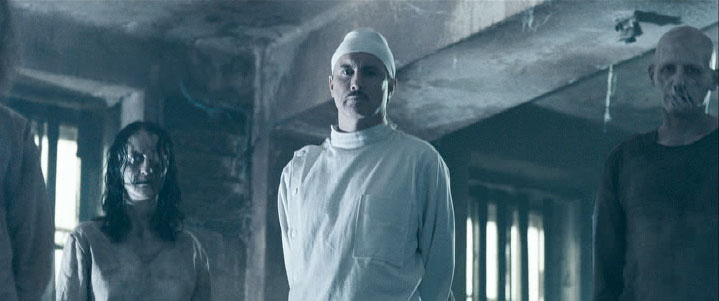
It's a shame this is all so shoddily done, because there could have been a fun movie here. The idea of a treasure hunt in a haunted house—not the steamy industrial basement of a haunted asylum—holds a lot of possibilities: different surprises in each room, outlandish clues, conniving characters, shifting loyalties, and so on.
Count me disappointed. Not as if I had any right to be, of course. The movie after all is called Return to House on Haunted Hill -- a title which, while evocative, doesn't even begin to sound grammatically correct.
What is there to say about Fahrenheit 451? It has been around for just over 56 years, and it thus merits a detailed review from yours truly. But honestly, without the recommendation of a crony, I would have never heard of this piece of trash.
That was a joke.
Fahrenheit 451 is one of the more remarkable books of our time. Sure, the text has its share of warts. The characters are more like caricatures, over the top and thin in their complexity. Ray Bradbury indulg
But still.
The caricatures are appropriate. The only fellow with depth and dynamics is Guy Montag, and that is because he is the only human struggling for some truth. By my definition, a full character is one who is making that effort, whatever truth it may be. Montag is -- for those not familiar with the story -- a fireman. His job is to set fire to books so that no one will read and consequently understand the hopelessness of reality.
The book burning is not a government mandated censorship, as in the case of 1984. Instead, it is a society-built degradation of the written word. Society has rejected the black and white messages bound in leather and paper. Burning books is better, according to most of the citizens of his world (including his suicidal wife), than to watch TV. Most the people in this world demand live inside entertainment, ignoring those inner voices that ask, "Is this it?"
Montag must find more. He must find it for himself, and he believes he must find it for society.
The incredible use of comparison does serve a purpose. Bradbury admits his overuse of metaphor and simile in the afterword, but the writing style creates a pulpy, film-noir weirdness to the words. The comparisons are sometimes wonderful, sometimes outrageous. They create a tone of 'hey, this can't be real,' while the content (human apathy, the limitation of the written word) pounds the reader's reality. The disharmony is symphonic. The previous sentence is a metaphor, for those paying attention.
I said I wasn't going to talk about the descriptions, but here's another example: "It was a stroll through another store, and his currency strange and unusable there, and his passion cold, even when he touched the wood and plaster and clay." These over-the-top descriptions do some of the same work as the comparisons.
The ending echoes Mark Twain's The Adventures of Huckleberry Finn in which Huck and Jim return to the hometown, and all is well in the world. Well, not really, as Twain well knows. Tom is still enslaved. Huck's "rescue" from one slaver delivers Jim to his former slaver. A helplessness moves past dramatic irony. No one in the story notices a permeating stink because each person no longer notices the odor. Huck (and Twain's) solution is to move out of society, to head west into the not-yet-civilized Western America.
The same goes in Fahrenheit 451. Bradbury is acutely aware that books are useless; they are physical objects. They are pieces of paper with words on them. Worse, 85 percent (a rough estimate) of those words are not worth the paper on which they are printed. To see books as the saviors of humanity is not naïve; it is dangerous. Rely on your survival manual in the middle of the desert, and you will probably die of thirst.
The absolute value of books is separate from their personal value that has lifted the souls and opened the minds to countless individuals. But everyone in Bradbury's world, including the exiled book readers themselves, have lost that personal love for the feel of text on paper and the smell of vellum as it ages yellow.
Ray Bradbury's conscious control of these elements, among others, shows his craft. Disagree with his techniques, but do not disagree that he employed those techniques with a purpose. His sentiments are not new. Lots of people have questioned the limits of language (for more on this, Google Jacques Derrida and Deconstruction Theory). The style Bradbury uses, the pulpy sci-fi style that is one reason this book still runs strong in popularity and relevance a half century later.
Fahrenheit 451 has become (and, I think, was designed to be) that thing that caused books to burn. The text or its author offers no answers to the question poised. Instead, if offers a story about a man seeking a truth. Where many forgettable texts use the soapbox, Bradbury used the microscope and telescope.
Observationalists like Bradbury have held the literary court for the past century (if not before). What is the next step? The problem of the human condition has been defined by Bradbury and his peers (of whom there are few), so where's the big leap forward that will not only acknowledge reality at hand, but which will also suggest a solution that will evolve the human of the species? Possibly, there is no answer in this generation or the next. Perhaps humans will go extinct before realizing an answer to even one of its defining questions.
FAMOUS LAST WORDS
Fahrenheit 451 is a brilliant, disturbing novel. It is as meaningful today --- perhaps more so --- as it was when it was written in 1953.
Possibly, there is no Bradbury 2.0.
Until there is, keep your copy of Fahrenheit 451 handy. You never know when some person needs a fire's warmth.