
The way you approach Final Fantasy VII Advent Children will have a lot to do with your history as a gamer, and more specifically, your history with the Final Fantasy series. There is no way around it: Final Fantasy VII Advent Children is fan service. Glorious, beautiful, well-executed fan service. Those who enjoyed Final Fantasy VII and wanted to see the story continue get their wish wit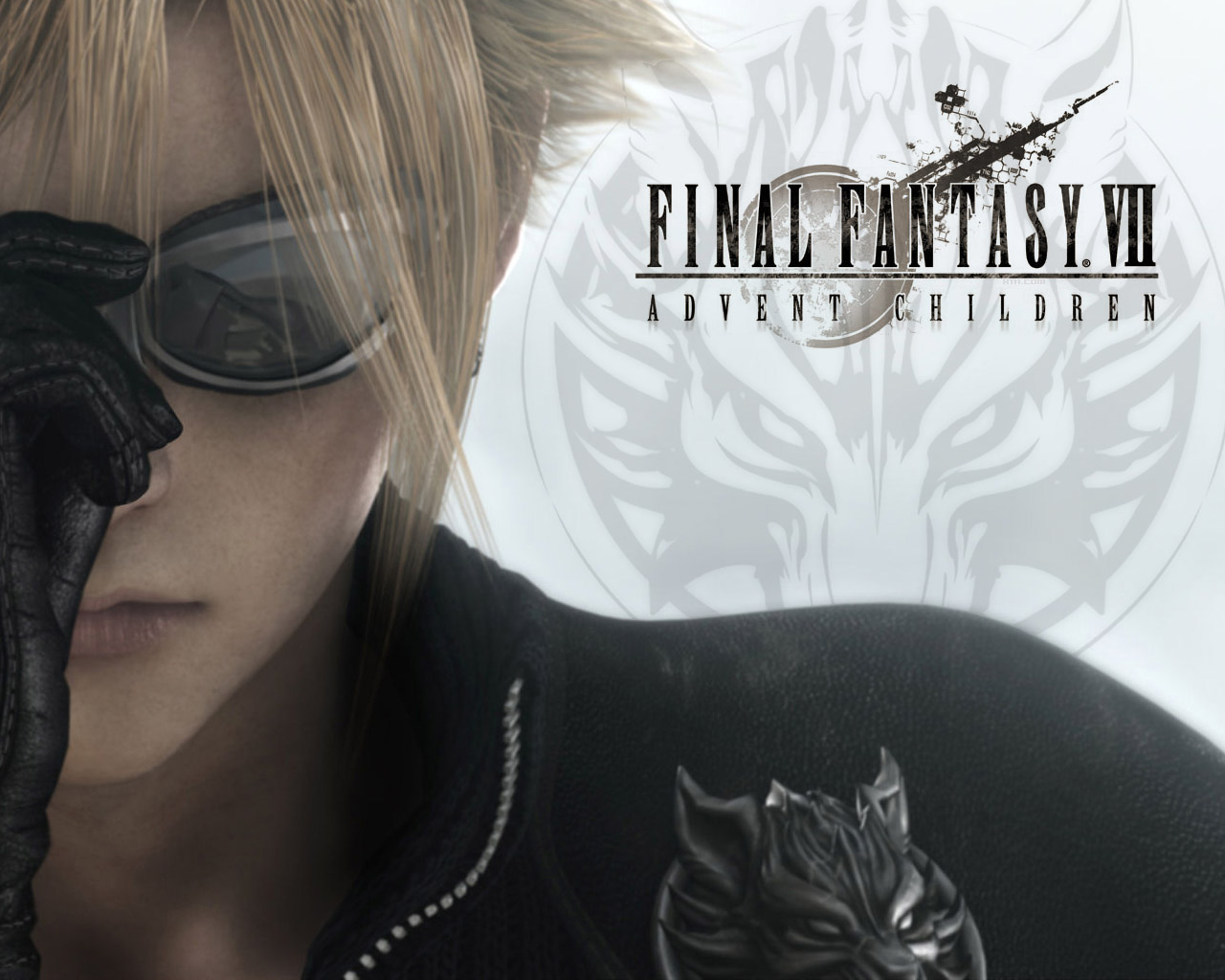
To everyone who considers anime a superior form of entertainment to American fare: Congratulations! You've just been tricked into watching a Hollywood movie. The plot is something that you could see at any multiplex theater between the months of May and August, and usually the rest of the year too. It's just an excuse to get the hero involved in some dazzling action scenes, and when it's all over, Cloud saves the day in an unsatisfying deus ex machina that leaves everything open to interpretation.
Unless you've played the game (or watched a friend play it, or seen some cosplay, or read some information online), there's no chance of getting to know the characters. Most sequels have that problem, but here it's magnified because the original was about 40+ hours' worth of gameplay. Compare that to a two-hour movie and that's a whole lot of back-story to catch up on. The movie tries to explain things with some introductory narration and willy-nilly flashbacks, but after trying to advance the story for 40 minutes, it just gives up and switches to pure action and fighting. There are even some cute comedy bits early on, but the lasting impression is one of fighting, fighting and more fighting. For old-time Final Fa
The action sequences are so kinetic and over-the-top that that border on the orgasmic. Characters leap and dive on-screen at a frenzied pace, pulling off some of the most ludicrously jaw-dropping action sequences you will ever see in any medium, ever, like a three-on-one sword fight performed on motorcycles at high speed, with each antagonist leaping into the air from motorbike to motorbike. It is actually too much to take at times, the pace so insane that the eye simply fails to keep up with the action on-screen. The synapses firing in your brain simply start rejecting the information being passed to it, like water overflowing from a sink. You find yourself laughing out loud at the utter absurdity of it. Simply put, you have never seen anything like the action in Advent Children. It is awesome in the literal sense of the word, in that it fills you with awe.
As for the animation itself, it is kind of frightening. Rendered entirely in CGI, the shocking advancements in compute

The inescapable fact is that Advent Children has been created like a video game, not like a film. Like a never-ending cut scene, it lives by different behavioral rules than we have come to expect from a film; it does not need to pay the same attention to explaining itself or having continuity from one sequence to another. One can argue that as a film, Advent Children fails to take these fundamental elements into account—like creating a story that its audience can actually follow—but all Advent Children sets out to do is absolutely blow your senses away; in this sense, the film is a magnificent success.
Just think, though—if some of that animation budget had been spent on story development, this movie could have transcended its status from high-priced fanfiction to a timeless work of art.
Dig into the "Shadow" novels that make up what might be called the "second wave" of Orson Scott Card's Ender saga, and you'll find books that stand in sharp contrast to the three novels that followed Ender's Game itself. Those titles — Speaker Of The Dead, Xenocide and Children Of The Mind — were deeply contemplative and centered on the relationships between Ender and a host of, shall we say, rather emotionally tortured characters. The Shadow novels retain the interest in interpersonal dynamics (Card is basically incapable of writing any novel that lacks such a focus), but the narrative goals are all about action and suspense this time, without asking so much from the reader in the way of a furrowed brow.
Following Ender's victory against the Formics, the world is a changed place. With the alien enemy defeated, humanity, once united under the Hegemon, has quickly settled back into business as usual. Nations reestablish themselves and rattle sabers. A new world order is indeed in the offing. Ender is quickly shipped off to a colony world to calm global concern over what America might do, led by such a great military leader. And the remaining graduates of Battle School return to their home countries to try to settle into a life they never really grew up enough to know in the first place.
The new X factor is Achilles de Flandres, Bean's bete noire from his childhood as a Rotterdam street urchin. Achilles is psychotic, but a cunning manipulator. Having gotten kicked out of Battle School by Bean, Achilles has ingratiated himself to the Russian government, and he arranges for the abduction of every member of Ender's "jeesh," the Dragon Army — the Battle School platoon he commanded in his victory against the Formics. Power hungry countries all want Ender's former soldiers under their control, as valuable assets in whatever wars yet loom on the horizon. But Achilles has plans of his own, and finds more than enough power hungry countries eager to be led, and misled, by his machinations.
Bean is singled out for special treatment by Achilles, who just tries to assassinate him outright. Bean, the ultimate survivor, tries to stay one step ahead of Achilles' plans. With his s
Shadow of the Hegemon is a political and military thriller, straight up. What it lacks in intellectual and thematic muscle it tries, more or less successfully, to make up for with white-knuckle excitement. It's enjoyable on those terms, though too often, events click too conveniently into place in order to get the plot where Card wants it to go. For instance, given their centuries of mutual animosity, it's v-e-r-y hard to believe that even Achilles could be such a winning and charismatic person as to persuade both India and Pakistan to withdraw its armies from one another's borders with a heap of sugar-coated and all too clearly bogus promises — and do so in the space of a single high-level meeting with Pakistan's leader.
Its hard to ignore, in fact, the problems here are too plentiful for me to elaborate on, but here's a quick list. With few exceptions, the characters all talk the same way and think the same way; any differences don't emerge from what the characters do but instead are told to us--explicitly--by Card in excruciating internal monologues. Unlike in Ender's Game, where the Battle School children were still unmistakably children, here the fact that most of the chief players are under 20 hardly plays a role in the story. Achilles is a terrible villain; neither terrifying nor sympathetic, he spends the book as a plot device, raising problems that Bean (and his friends) can go in and fix. The character of Peter Wiggin is massacred--massacred!--compared to his depiction in Ender's Game. The second chapter of Ender's Game alone, when Peter nearly kills Ender and then cries by Ender's side afterward, still sends chills down my back; no scene with Peter in Shadow of the Hegemon made him out to be anything other than another plot device.
I know these books predate the Matt Damon Bourne movies, which were casually based on the Robert Ludlum novels. But with their slick pacing and sense of urgency laced with paranoia, they subscribe to much the same race-against-time escapist sensibility. If Shadow of the Hegemon were a movie, it would be shot entirely with hand-held cameras and be edited by someone whose Ritalin was withheld from him until he finished the job.
FAMOUS LAST WORDS
Okay, so maybe the book isn't that frantic. But while readers who have followed this series from the start may find themselves disappointed to see the whole thing steering towards popcorn entertainment, I kind of found it refreshing that Card was able to deliver such a novel at a point in his career that many fans had begun to believe was inching past its sell-by date. Or perhaps it was simply that, having gotten all of the spiritual angst wrung out of the tale following the exceedingly serious Xenocide and Mind, and riding the wave of renewed goodwill that followed the surprising artistic success of Enders Shadow, Card decided it was time to give Ender fans a plain old-fashioned ripping yarn.
Thing is, he delivered the whole package in Enders Game. So despite its pleasures, Shadow of the Hegemon is yet a shadow of this saga's established greatness.