
Crash tells interlocking stories of whites, blacks, Latinos, Koreans, Iranians, cops and criminals, the rich and the poor, the powerful and powerless, all defined in one way or another by racism. All are victims of it, and all are guilty it. Sometimes, yes, they rise above it, although it is never that simple. 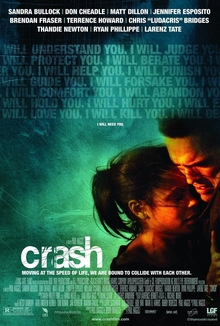
The result is a movie of intense fascination; we understand quickly enough who the characters are and what their lives are like, but we have no idea how they will behave, because so much depends on accident. Most movies enact rituals; we know the form and watch for variations. Crash is a movie with free will, and anything can happen. Because we care about the characters, the movie is uncanny in its ability to rope us in and get us involved.
Crash was directed by Paul Haggis, whose screenplay for Million Dollar Baby led to Academy Awards. It connects stories based on coincidence, serendipity, and luck, as the lives of the characters crash against one another other like pinballs. The movie presumes that most people feel prejudice and resentment against members of other groups, and observes the consequences of those feelings.
One thing that happens, again and again, is that peoples' assumptions prevent them from seeing the actual person standing before them. An Iranian is thought to be an Arab, although Iranians are Persian. Both the Iranian and the white wife of the district attorney believe a Mexican-American locksmith is a gang member and a crook, but he is a family man.
A black cop is having an affair with his Latina partner, but never gets it straight which country she's from. A cop thinks a light-skinned black woman is white. When a white producer tells a black TV director that a black character "doesn't sound black enough," it never occu
You see how it goes. Along the way, these people say exactly what they are thinking, without the filters of political correctness. The district attorney's wife is so frightened by a street encounter that she has the locks changed, then assumes the locksmith will be back with his "homies" to attack them. The white cop can't get medical care for his dying father, and accuses a black woman at his HMO with taking advantage of preferential racial treatment. The Iranian can't understand what the locksmith is trying to tell him, freaks out, and buys a gun to protect himself. The gun dealer and the Iranian get into a shouting match.
I make this sound almost like episodic TV, but Haggis writes with such directness and such a good ear for everyday speech that the characters seem real and plausible after only a few words. His cast is uniformly strong; the actors sidestep cliches and make their characters particular.
For me, the strongest performance is by Matt Dillon, as the racist cop in anguish over his father. He makes an unnecessary traffic stop when he thinks he sees the black TV director and his light-skinned wife doing something they really shouldn't be doing at the same time they're driving. True enough, but h
That traffic stop shows Dillon's cop as vile and hateful. But later we see him trying to care for his sick father, and we understand why he explodes at the HMO worker (whose race is only an excuse for his anger). He victimizes others by exercising his power, and is impotent when it comes to helping his father. Then the plot turns ironically on itself, and both of the cops find themselves, in very different ways, saving the lives of the very same TV director and his wife. Is this just manipulative storytelling? It didn't feel that way to me, because it serves a deeper purpose than mere irony: Haggis is telling parables, in which the characters learn the lessons they have earned by their behavior.
Other cross-cutting Los Angeles stories come to mind, but Crash finds a way of its own. It shows the way we all leap to conclusions based on race -- yes, all of us, of all races, and however fair-minded we may try to be -- and we pay a price for that. If there is hope in the story, it comes because as the characters crash into one another, they learn things, mostly about themselves. Almost all of them are still alive at the end, and are better people be
Not many films have the possibility of making their audiences better people. I don't expect Crash to work any miracles, but I believe anyone seeing it is likely to be moved to have a little more sympathy for people not like themselves. The movie contains hurt, coldness and cruelty, but is it without hope? Not at all. Stand back and consider. All of these people, superficially so different, share the city and learn that they share similar fears and hopes. Until several hundred years ago, most people everywhere on earth never saw anybody who didn't look like them. They were not racist because, as far as they knew, there was only one race. You may have to look hard to see it, but Crash is a film about progress.
The way you approach Final Fantasy VII Advent Children will have a lot to do with your history as a gamer, and more specifically, your history with the Final Fantasy series. There is no way around it: Final Fantasy VII Advent Children is fan service. Glorious, beautiful, well-executed fan service. Those who enjoyed Final Fantasy VII and wanted to see the story continue get their wish wit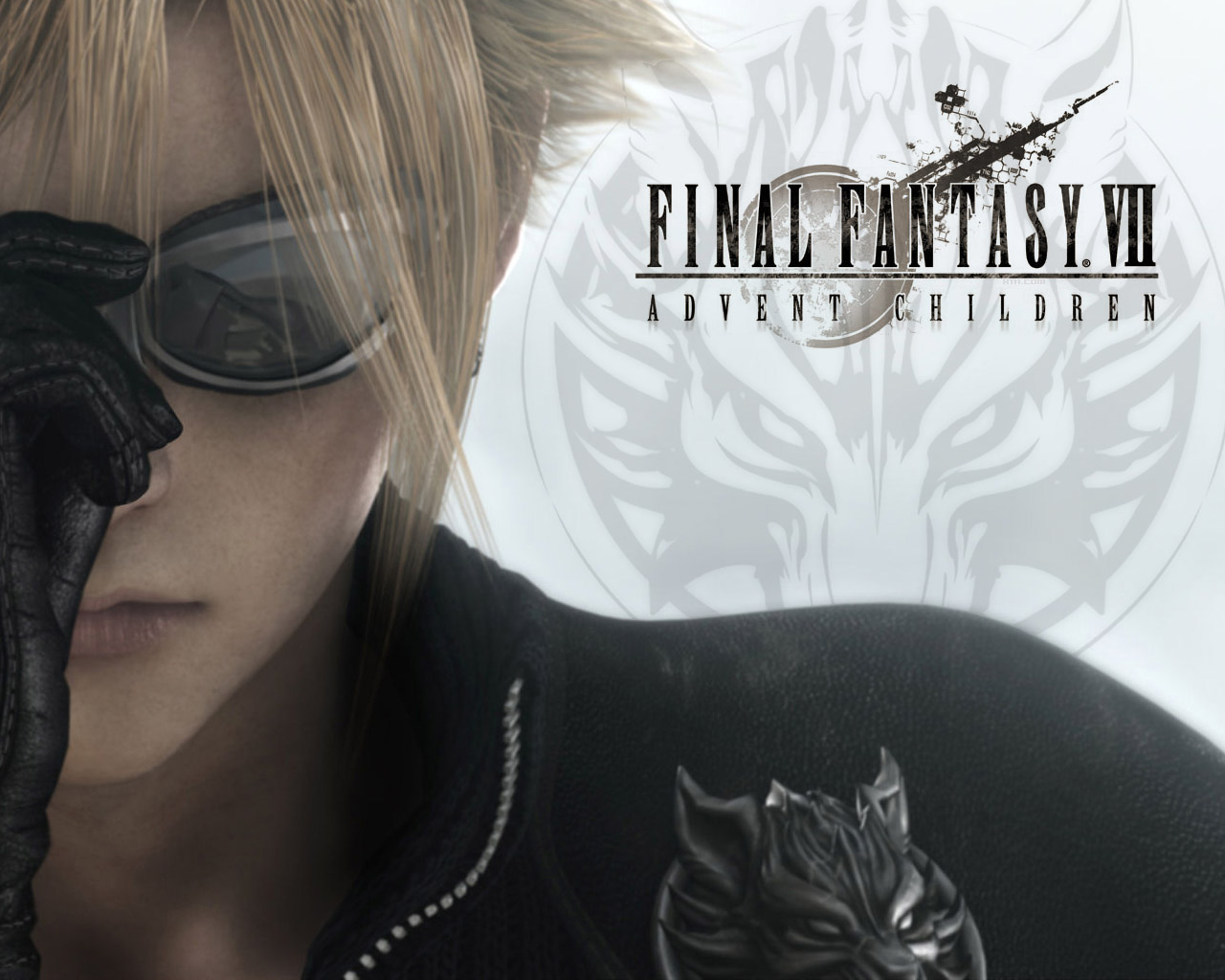
To everyone who considers anime a superior form of entertainment to American fare: Congratulations! You've just been tricked into watching a Hollywood movie. The plot is something that you could see at any multiplex theater between the months of May and August, and usually the rest of the year too. It's just an excuse to get the hero involved in some dazzling action scenes, and when it's all over, Cloud saves the day in an unsatisfying deus ex machina that leaves everything open to interpretation.
Unless you've played the game (or watched a friend play it, or seen some cosplay, or read some information online), there's no chance of getting to know the characters. Most sequels have that problem, but here it's magnified because the original was about 40+ hours' worth of gameplay. Compare that to a two-hour movie and that's a whole lot of back-story to catch up on. The movie tries to explain things with some introductory narration and willy-nilly flashbacks, but after trying to advance the story for 40 minutes, it just gives up and switches to pure action and fighting. There are even some cute comedy bits early on, but the lasting impression is one of fighting, fighting and more fighting. For old-time Final Fa
The action sequences are so kinetic and over-the-top that that border on the orgasmic. Characters leap and dive on-screen at a frenzied pace, pulling off some of the most ludicrously jaw-dropping action sequences you will ever see in any medium, ever, like a three-on-one sword fight performed on motorcycles at high speed, with each antagonist leaping into the air from motorbike to motorbike. It is actually too much to take at times, the pace so insane that the eye simply fails to keep up with the action on-screen. The synapses firing in your brain simply start rejecting the information being passed to it, like water overflowing from a sink. You find yourself laughing out loud at the utter absurdity of it. Simply put, you have never seen anything like the action in Advent Children. It is awesome in the literal sense of the word, in that it fills you with awe.
As for the animation itself, it is kind of frightening. Rendered entirely in CGI, the shocking advancements in compute

The inescapable fact is that Advent Children has been created like a video game, not like a film. Like a never-ending cut scene, it lives by different behavioral rules than we have come to expect from a film; it does not need to pay the same attention to explaining itself or having continuity from one sequence to another. One can argue that as a film, Advent Children fails to take these fundamental elements into account—like creating a story that its audience can actually follow—but all Advent Children sets out to do is absolutely blow your senses away; in this sense, the film is a magnificent success.
Just think, though—if some of that animation budget had been spent on story development, this movie could have transcended its status from high-priced fanfiction to a timeless work of art.