
The rules of first-person shooters are changing. Videogames that engage the player in acts of war have always promised one thing; cover. During times of extreme duress the player has always had the option of re treating behind a wall or group of immovable sandbags in order to escape their assailants. Battlefield: Bad Company changes all that.
No longer is the inside of a house a safe haven for fleeing soldiers. Walls, sandbags, fences, and other formerly indestructible objects can now be torn down with a blast from a grenade or rocket launcher. Bad Company, while not perfect by any means, changes the formulaic gameplay of war-based first-person shooters enough to warrant the attention of the many fans of the genre.
The Battlefield series has always been a PC-oriented franchise. Battlefield 2: Modern Combat was the first to make the jump to consoles during the twilight of the Xbox and the infancy of the 360. While it was enjoyed by some, the immense praise that the series was accustomed to was missing. Bad Company not only represents the first story-based game in the series, but it's also the first product to utilize the all-new Frostbite engine which is responsible for all of the luscious destruction that I just mentioned.
Bad Company follows one Private Preston Marlow, a new recruit to a division of the army known simply as Bad Company, or B-Company for short. It's a group of misfit soldiers -- complementing Marlow are Sarge, Haggard and the love struck Sweetwater -- each with his own personality and quippy dialogue. Though the missions in the campaign begin innocently enough with standard seek and destroy objectives, the team's motivations quickly take a turn once the promise of personal wealth enters the equation.
It's interesting to see how DICE dances around the politically charged climate of present day. Especially when you consider that your group of soldiers is essentially abandoned by United States military command fairly early on. DICE could have taken a more politi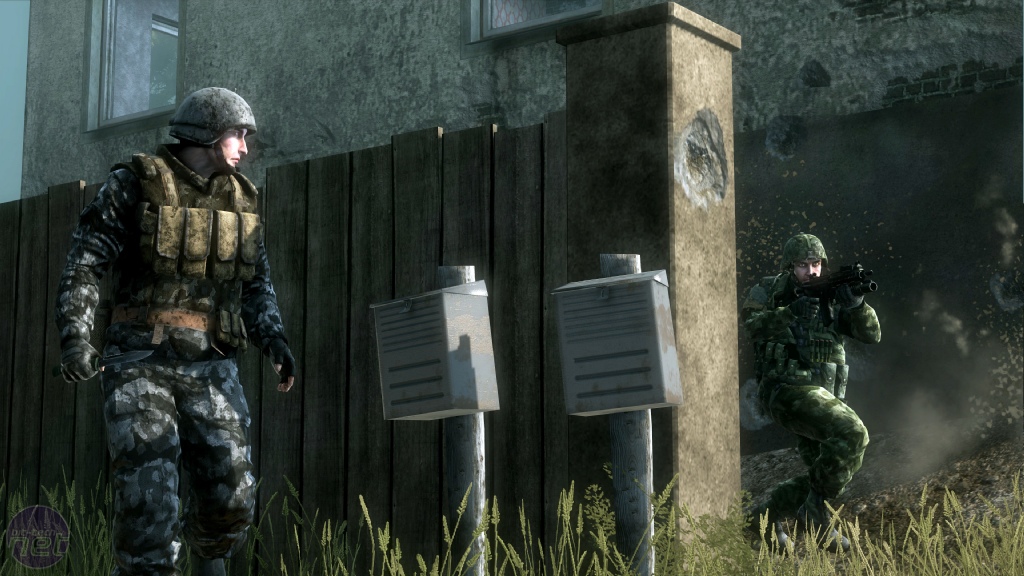 cally slanted approach but Bad Company does a good job of keeping things light-hearted and fun throughout the action.
Sadly it's that same light-hearted appeal that hurts the action in BF: BC a bit. War is intense yet the characters in Bad Company are constantly joking around and making fun of one another during battle. The comedy bit just doesn't quite fit in with the incredible level of action on screen.
That having been said, it's clear that Battlefield: Bad Company isn't necessarily trying to be as hard-edged as the drama-charged Call of Duty 4. This is evidenced -- beyond the over-the-top personas -- by both the health and respawn systems. When Marlow begins his adventure he is immediately introduced to his trusty health injector. Players can whip that sucker out, slam it into Preston's chest and his health is instantly restored. While you'll need to wait a handful of seconds before repeating the process, there are moments when you'll feel like all you're doing is running around and sticking yourself with that precious needle. Not exactly something you'd see on CNN war footage.
Next up is the respawn system which will remind many of the cryo chambers found in BioShock. When you die in most single-player games the world resets to the point of your last saved checkpoint. Not so in Bad Company. Instead you'll essentially respawn back onto the field of battle with any damage that you may have caused in your previous life still intact and any downed enemies still deader than a doornail. I can't help but feel like that system detracts from the strategy and overall intensity of the battles. Each life carried very little significance for me as I could charge in, take o ut a few blokes and trust that they'd still be gone when Preston returned to the living.
Where the gameplay of Bad Company positively separates itself from the throng of other war-based releases is the destructibility. At this point it sounds almost cliché but the Frostbite engine does indeed change the way you play. Hiding behind walls is no longer safe for you or your enemies. I can't tell you how many times my dwindling health sent me retreating into a house, only to have the walls shredded by an onslaught of tank shells.
There's no doubt that the destruction wouldn't have such a profound impact if it didn't look and sound so damn good. Bad Company isn't a graphical masterpiece by any means, but launching a grenade into the side of a wall and watching the debris and smoke spew out of the formerly whole structure is a sight to see. DICE also did a good job of placing plenty of explosive barrels, crates and gasoline tanks around the environment so there's never of shortage of things that go boom.
However, the visuals are not without issues. The lack of vertical sync shows its ugly face fairly often, particularly in the first level. There's also an odd film grain that, while I found it endearing to the overall style, might be lamented by some. There are also moments of wonky physics and other oddities, but nothing that overly hurts the experience.
Throw in some of the best audio effects I've ever heard in a videogame and Bad Company becomes more a treat for the ears than the eyes. The High Dynamic Range Au dio creates different audio effects for gunfire, explosions and pretty much every other sound effect you can imagine. Want a real audio treat? Stand inside a house and blow out one of the walls with Preston's grenade launcher then stop and listen to the sound reverberate as the debris comes raining down. Other impressive auditory delights include the sound of a tank shell whizzing by your head and launching a fleet of missiles from an airborne helicopter. While the dialogue from the characters might be a bit too cheeseball for some, the sound effects, classic Battlefield theme music and overall audio design more than pick up the slack.
The story that's told through in-game and in-engine cutscenes is serviceable but nothing award-winning. The dialogue is slightly cheesy and over-the-top and none of the characters are all that inspiring. Marlow is sort of a shell of a hero and is more "along for the ride" than anything else. The main villain, the one who's keeping the quartet of militants from their riches, looks mean but never really comes across as the frightening hard ass as intended.
A big problem that most will have with Bad Company's campaign is that it can't be played cooperatively. With four soldiers built in to the storyline one would think that the developers would have implemented four-player co-op, yet there's none to be found. In this day and age it's pretty much inexcusable to not have cooperative play when it makes so much sense with the core game design.
Thankfully, where the single-player stumbles, the multiplayer shines. The Battlefield franchise is known more for its online matches than its solo play but sadly I cannot vouch that Bad Company is no different. Why? For some uncountable reason, I am unable to connect the multiplayer and therefore, I dont have a say on this....
Battlefield: Bad Company is a great addition to the long-running series, despite the fact that it leaves the comfy confines of the PC world. The added storyline gives newfound depth to the formerly shallow single-player mode, despite the fact that the dramatization pales in comparison to what we’ve seen from Call of Duty 4. Where Bad Company truly shines is in its multiplayer (from what rumors tell) and the technology that drives the game forward. Both raise the bar in their own right and give the competition something to strive for. In this summer relatively devoid of solid first-person shooters, Bad Company does enough to earn your hard-earned dough.
It's pleasing to see that Square Enix — despite having the Final Fantasy, Dragon Quest, and Kingdom Hearts mega franchises in its line-up — is still willing to go boldly into new frontiers with the release of original g ames like The World Ends With You. This role-playing game eschews the company's tried-and-true swords-and-sorcery settings and instead transports the action to modern-day Tokyo. Although there's nary a chocobo or keyblade to be found here, The World Ends With You still incorporates some of the company's best-known trademarks and wraps plenty of innovative new gameplay around them, particularly an initially mind-bending dual-screen combat system. The result is a game that manages to feel familiar and yet strikingly new at the same time, and one that deserves to be ranked alongside Square Enix's best works.
At first glance, the game seems little more than a pastiche of all the things that have made the famed Japanese developer's RPGs massive successes in the past. Angsty teen hero with an absurdly angular haircut? Check. Complex, team-based combat system? You betcha. Detailed customization options with weapons and armor that border on the anal retentive? Fer sure. But The World Ends With You merely uses these Square Enix conventions as a launching pad for a unique experience that is both impressive in its use of the Nintendo DS's capabilities and compelling in its storytelling.
The most apparent difference from previous Square Enix games is location. The World Ends With You is set not in an imaginary kingdom, but entirely within Tokyo's fashion and shopping hub, Shibuya. Several real-world landmarks from Shibuya are re-created within the game, such as the train station, Shibuya Crossing, Hachiko's statue, Dogenzaka, and more. However, this shift to a modern setting isn't mere window dressing, given that it greatly complements the game's overall design. Developer Jupiter Corp has stuck to a character look s imilar to that found in the Kingdom Hearts series, and though the far-out fashion seemed somewhat out of place within that game universe, here it seems entirely appropriate to the fast-paced and fashion-conscious world of trendy Tokyo.
The story itself is a little like The Matrix, and a little like Battle Royale. The game follows main character Neku Sakabara as he's forced to play The Reapers' Game, a sinister competition in which the (mostly) evil Reapers assign players, like Neku, a task every day for seven days. Fail to complete the task within the set time limit and the player is completely erased from existence. Strangely, none of the other inhabitants of busy Shibuya can see Neku or the other players, although a mysterious pin that Neku finds on his person when he first wakes up in Shibuya lets him read people's minds. What's even more disconcerting are the large groups of strange creatures now roaming the streets. Although normal people can't see these creatures — called the Noise — they can see Neku, and they're out for blood. Along the way, Neku is forced to make pacts with other characters because forming these bonds and fighting in pairs is the only way to do damage to the Noise.
There are some genuine twists in this game's intriguing story, and there is also plenty of heartfelt emotion from its teenage protagonists, which makes for some truly touching moments. The themes explored here — finding your identity, overcoming insecurity, teen angst, coping with guilt, the weight of obligation — are nothing new for a Square Enix game, but they seem somewhat more resonant and identifiable because they're coming from characters who use mobile phones, eat fast food, and who do other things that ground them in the same world we live in.
Traversing the world of Shibuya is done through the stylus and touchscreen, but battles are where it gets more complex. The game's setting might be somewhat of a departure for a Square Enix game, but the comba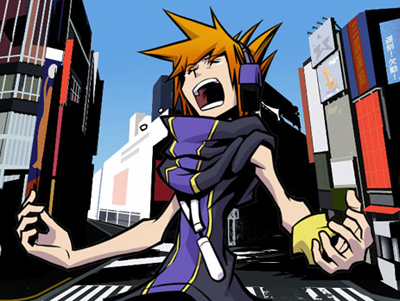 t is a completely new take that uses both of the DS's screens at the same time. Neku and his partner share the same health bar, while the Noise they're fighting appear on both screens at once (although not necessarily in the same location). On the bottom screen is Neku, whom you control via different directional swipes with the stylus on the touchscreen. Neku uses objects called psych pins to attack, and each type of pin requires a specific move with the stylus to unleash its power. These moves can include rapidly tapping the screen, performing slashes across enemies, quickly scratching empty space, drawing circles with the stylus, and more. There are also some pins that require you to yell into the DS's microphone.
The presentation of The World Ends With You impresses right from the game's beginning. Graphically, the game just sparkles, and its stylized version of Shibuya pops with color and detail. Large, colorful character models w ith speech and thought bubbles are used for the game's many cutscenes, and the battles sport some pretty effects. There are also a wide variety of strange-looking Noise that Neku and crew will run across, ranging from insane-looking kangaroos and penguins to gigantic bats. Sound is another area in which this game excels, with enough snippets of dialogue packed in to put other DS games to shame. (One of your partners yelling "There's a party in my mouth" when you give him a piece of food stands out.) Of particular note is the game's soundtrack, which is made up of an eclectic mix of J-Pop, hip-hop, and rock songs that get into your head and refuse to leave. Fitting such a large mix of music on a DS cartridge is impressive enough, but having decent songs in that mix is a luxury few games have.
Flawless presentation, gameplay depth, an engaging story, and innovation all add up to make The World Ends With You a worthy addition to the already-impressive pantheon of Square Enix works. There's very little to complain about in this package, which makes The World Ends With You a must-have for any DS owner needing an RPG fix.
Despite a few stumbles, this is one world I don't want to end.
 Piece of Advice
First off, looking through the net regarding the race issues within the game, I honestly think it's been blown well out of proportion.
There was no fuss when the gamer was shooting the heads off the Hispanics in RE4. The African American community need to get over themselves as some of them are digging up ambiguities over nothing.
It's a piece of interactive fiction...get over it.Anyway, on to the review....
The Resident Evil franchise has come a long way since it was scaring the pants off gamers back in 1996 with crude polygon blocks. Thanks to Hollywood move adaptations and Milla Jovochich’s legs, the T-Virus, Umbrella Corp and Racoon City are almost common knowledge these days. So now after many gaming titles, across five different platforms and over 35 million copies sold worldwide – what can Capcom possibly offer next?
When Shinji Mikami rebooted the Resident Evil series with the landmark survival-horror game, Resident Evil 4, he set the bar unreasonably high for any subsequent sequels. Arriving in gorgeous form on the underdog GameCube, RE4 introduced vastly-improved controls, a truly unsettling new type of zombie-like enemy, and a massive adventure that all but put to rest any complaints about the series' typical game length. It featured Resident Evil 2 co-protagonist Leon Kennedy -- mostly alone and mostly in the dark -- and was, for the most part, an excellent, chilling, frightful action game. Resident Evil 5 , on the other hand, is less of a survival-horror game and more of a survival-action game in which you are never alone, and rarely in the dark.
This completely saps the horror out of Resident Evil 5 . It is very nice to have an A.I. partner like Sheva around watching your back, and it's a worthwhile spin on the classic RE formula. But her presence adds a layer of comfort that extinguishes the creepy, unnerving experience that running through the game solo would have created. The much-vaunted "fear in broad daylight" concept, while briefly unique, is overrated, too, as the feeling of being completely exposed out in the light of day soon gives way to the usual RE brand of action which forces you to stick and move, stand and shoot. The difference here is that in past RE games shadow was never used as an advantage -- the series has never been a Metal Gear stealth game -- and so, suddenly being thrown in the heat of the desert sun is no fundamentally different than creeping around in the darkness. It's mostly a gimmick. Seeing your highly-detailed enemies lunging after you is pulse quickening for sure, but once you get over the novelty of it, your survival instincts kick in and it's the same old Resi
 dent Evil all over again, except this time with the lights turned on.
Resident Evil 5 offers some great level designs. The opening scene place you in a poverty stricken village filled with narrow alley-ways and confined spaces like two or three roomed houses that you can try and defend by pushing bookcases in front of windows. Zombies will smash down doors, leap in windows or climb in from the roof to ensure that you squeal like a little girl in front of your flatmates. Later on this sense of claustrophobia is counted with a scene that takes place on a cliff-face overlooking a huge desert canyon - fighting off a giant maggot thing with wings and nippers. Next you will be in a pitch black mine.
Here it is so dark that it requires one partner to light the way with a two-handed battery operated torch. The genius behind this is that it leaves just one other player to fend off attackers when they suddenly appear in your team-mate’s beam of light. Resident Evil 4 sometimes felt a little recycled in the environment department so it’s great to see that Capcom have put the next-gen technology to use creating exciting surroundings. I did find it a bit odd however the way Chris felt the need to smash through glass windows by jumping head-first every time. Surely knocking the glass out with your gun or maybe even just opening it would be a safer option? I guess it just takes a real man like Chris to open a glass window with his skull.
Firstly, Resident Evil 5 isn’t about plain old zombies now. Mindless brain-eating zombies are totally old school these days. Instead the poor inhabitants of this African town have been infected by a much more serious strain of the virus causing a wealth of ugly side-effects. They are smarter (they operate machine-gun turrets and ride motorcycles now!), fast and sometimes very difficult to take down. While some can be killed by careful headshots, others will mutate into other, more destructive forms when wounded. As Chris mentions early on, “…they don’t move like any zombie I’ve ever seen.”
As in Resident Evil 4, players cannot target and move at the same time. Holding down L1 gives you a cross-hair (or the ultra stylish laser pointer) and R1 shoots. In order to move around you have to lower your weapon, preventing you from shooting while retreating…which is what I would be doing in most cases Chris and Sheva find themselves in. But this element of gameplay is one of Capcom’s finer creations and truly opens up that aspect of survival horror. It basically means that every shot counts – whether you aim for a leg to slow down your attacker or try for a well-placed headshot as a zombie charges for a taste of your juicy bits. The inability to fire blindly while running around like an idiot makes the combat intense and persona
 l. Not to mention the sparse ammo in the game that will cause you to curse every missed shot. The only main gripe with the combat is the hand-to-hand fighting with your knife. At times where you run out of ammo, your trusty blade is your only defense. But without being able to move while holding it, you are forced to just stand around and wait for them to come to you. Moving closer and then drawing your knife is often too time-consuming, leaving you vulnerable to their close quarter bites. Surely a burly lad like Chris can operate a knife at the same time as moving his legs?
The introduced concept of having a partner changes the dynamics of the gameplay considerably. Sheva can provide you with backup, direction when you’re lost, help you find items scattered around in crates, hold extra equipment that one person couldn’t carry and - most importantly – is someone to hear Chris’ wise-cracks and general banter. If you are low on ammo she will (if she posses any) throw you some from her inventory. Sheva will also cover your back and help you if you get pinned down in a tight spot. When playing single-player the AI that controls your partner is fairly clever and usually gives you a good sense of team-work.
That’s the good news.
The bad news is, for all of the improvements that Resident Evil 4 made, Resident Evil 5 only magnifies the franchise’s need for an overhaul. You have a cover system grafted onto a control schema that’s irrationally tank-like. For every level that borrows from Uncharted or Capcom’s own Lost Planet, you’ll face a series of corridors nearly copy/pasted from Resident Evil 2. And regrettably, the positives in these statements only bolster how, at its worst, Resident Evil 5 is simply derivative.
Resident Evil 4 was always going to be an albatross for its successors, but it’s the temerity with which Capcom treats it that’s really surprising. There’s so much reverential reuse of ideas, from basic combat to the big set-pieces, that it’s almost as if RE4 had a formula that could be copied.
Even if it did, a trick never looks quite as good the second time around. It’s not surprising that Resident Evil 5 was intimidated by its predecessor, and it’s not surprising that it believes imitation to be the most sincere form of flattery. It’s also not surprising that such reverence has created mechanical clichés, from barrels to chainsaws, as pervasive as item boxes ever were.
The other problem that's starting to bog down the Resident Evil series is that the bosses are gradually becoming more and more ridiculous. Either Capcom has started to run out of ideas, or they've truly lost sight of just how many giant ogres with huge, rumbling tumors they've created over the years. Likewise, our tolerance for writhing, wriggling, snake-covered bosses, and enormous tentacle-porn mons
 trosities has been sorely tested through the years. Is this really someone's idea of fun? Is this truly what Umbrella hath wrought? Seemingly so, but while the key encounters in the game may border on uninspired, their execution is still good fun. If only it weren't so derivative of things we've already seen. The same can be said of the much-vaunted Jill Valentine/Albert Wesker story arc. At this point, if you've followed the coverage of the game at all, you've probably already figured out who Jill is, and by the time you reach your fateful showdown with Wesker, it's hard to tell if he's evolved into this truly menacing near-deity, or if he's just hamming it up. Your mileage will vary depending on how much you love your CG cut-scenes, but while the production values are very high in RE5, expect few surprises.
Thankfully, a no-strings-left-untied ending may signal RE5 is the final stop for the franchise as we know it. That’s for the better as RE5 isn’t a stronger 3rd person action game than Gears of War 2, nor a better adventurer than Uncharted, and fans of Resident Evil 4 will probably find this one a bit of a step backwards.
Resident Evil 5‘s both pleasantly new school and frustratingly old school. It’s not even surprising, despite all this, that Resident Evil 5 is a good game. The surprising, and sad, thing about Resident Evil 5 is that it feels old. And thats never a good thing.
Two minutes left before rescue. We -- four of us -- have been fighting off the relentless, Infected zombie hordes for over an hour and a half, sharing painkillers and first aid, lending a helping hand or providing cover fire. And now, with a rescue boat nearing the dock, it's about time to climb aboard and head to safety.
We're in good health, and in reasonably good spirits, so Left 4 Dead's AI Director (which controls the pacing of encounters) kicks in: There's no way we're getting off that easily. A gargantuan Tank arrives -- a bloodthirsty spire of muscle and rage -- with a swarm of screaming, ravenous zombies in tow. Standing tall and side by side, we open fire.
Then, facing insurmountable odds and with panic dulling my senses, I do what any courageous, red-blooded gamer would do: I turn and bolt, making it to safety just in time to see one person pummeled into a lifeless pulp while the other two are pinned down, grappling with death's cold embrace.
It's a desperate ploy, but I know I only have to outrun the slowest member of our team. It's a sort of coerced teamwork -- one surviving member is all it takes to successfully complete a campaign, and I for one wasn't ready to be butchered yet again while helplessly firing off rounds at a never-ending swarm. To be honest, there's something beautiful about watching an efficient team with a well-rehearsed plan crumple under the weight of abject chaos.
Valve's Left 4 Dead is full of these little moments.
Plenty of games tout the cinematic experience, coupling melodramatic cut scenes with explosions, visceral combat and a story that's some variation on saving the world from Evil -- the standard Hollywood formula pressed onto a disc.
Valve's Left 4 Dead, on the other hand, takes the idea of interactive cinema and runs straight for the haunting, zombie-infested hills.
Please note: While it technically fits into the survival-horror genre, the game isn't remotely scary. Left 4 Dead's environments are dark and foreboding, and you might panic as a seemingly endless horde pours through the walls, but chances are you'll spend far more time cackling with glee at a timely escape (or crushing defeat). There's a comic, almost tacky, Day of the Dead sort of vibe, bolstered by the kitschy movie posters, graffiti-based arguments and conversations on the walls, and even the credits rolling at the end -- complete with "In Memoriams" for ... fallen teammates.
Left 4 Dead's environments are dark and foreboding, and you might panic as a seemingly endless horde po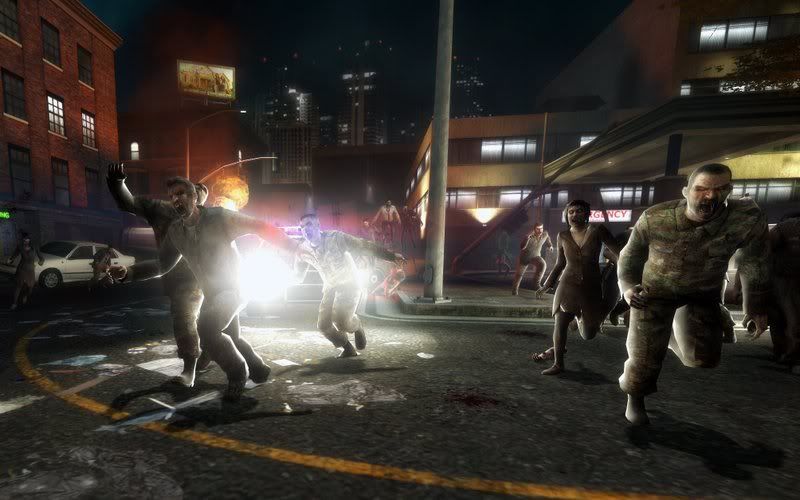 urs through the walls, but chances are you'll spend far more time cackling with glee at a timely escape (or crushing defeat). There's a comic, almost tacky, Day of the Dead sort of vibe, bolstered by the kitschy movie posters, graffiti-based arguments and conversations on the walls, and even the credits rolling at the end -- complete with "In Memoriams" for ... fallen teammates.
Nevertheless, you aren't playing a "movie," racking up kills as you move from cut scene to cut scene. Beyond a few snippets of background information on each character, there's no traditional narrative to be found, which is actually refreshing. We've all become fairly used to paging through dialogue trees and sitting through scripted sequences, so this might seem a little trite, but here goes: "Use your imagination."
The writing is on the walls: Who is Chicago Ted, whom no zombies are safe from? Did any of these people -- shuffling from safe room to safe room as we are -- make it out alive? The four Survivors you can choose from banter amongst themselves, cracking jokes to liven up the mood and even flirt, casually.
While I enjoyed piecing together their personalities based on how they reacted to my actions, I almost would've preferred some sort of bare-bones character creator, to really role-play a zombie apocalypse. Because interesting as the four Survivors are, the real story of the Campaign mode is about four players working together to cross the finish line, scooping up points and achievements along the way.
There aren't many scripts of any kind in Left 4 Dead. The game is divided into four Campaigns, with five maps each. While the maps are fairly linear and there are major set pieces -- a bridge to lower, a radio to respond to -- every element of the action is generated on the fly. The AI Director is Valve's answer to traditional spawn points, adjusting the pacing of the particular level based on how you're doing. Approach a barricaded building armed to the teeth with full health, and you can expect a gruesome experience. But if all four of your characters are limping along, the Director can be a bit merciful. While there are traditional difficulty settings, these only affect how much damage a Survivor can take before collapsing.
The end result is that you can repeat the same map countless times and get completely different experiences: Weapons aren't where they "should" be, power-ups appear in seemingly random places, a previously empty hallway becomes a hellish firefight. There are major events that remain the same -- always expect a Tank at a campaign's finale -- bu t for the most part you'll need to stay in constant communication with your partners, as it's hard to predict what will be around the next bend.
The game is ultimately about teamwork. Your fellow Survivors provide more than a few extra guns -- without them, you can be easily knocked onto the ground, or overwhelmed. As an added caveat, friendly fire is mandatory, so be ready to apologize for accidentally mowing down a comrade every now and then. There are a few safeguards: For starters, it takes quite a bit of damage to take a Survivor down, and once you are incapacitated, you can still fire your pistol at passers-by -- with unlimited ammo, just like in the movies!
But you will die, and sometimes you'll die often. While an entire team getting wiped out will simply have to start the map over again, if there's at least one Survivor, and a room with a closed door nearby, you might just hear someone clamoring for help. Yeah, it's kind of hard to feel bad for people when they're alive and well in a little while, but the occasional respawn point is literally a godsend with maps this long and brutal.
Versus mode takes the formula established by the campaign and adds four more players as the "Boss" Infected: mutated zombies with special abilities. The goals remain the same: Survivor players must escape, and Infected players must stop their progress. Versus mode felt in need of some serious balancing when I first attempted to compete. I was wrong.
I've played countless first-person shooters, and I can't honestly describe a situation where a skilled player couldn't simply abandon their comrades and at least score a few glory kills.
As the Infected, unless you've been randomly assigned to play as the Tank, you're rarely in any position to kill a Survivor. Instead, you've got to rely on the NPC zombie horde, using your own abilities to confuse your opponents, weakening them and forcing them to separate.
There are chinks in Lef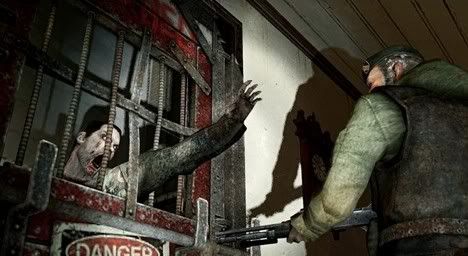 t 4 Dead's armor. The single-player campaign is little more than a training ground, or perhaps an opportunity to snag some achievements you may have missed -- while NPC Survivors are skilled, they lack the ability to coordinate or plan, which sort of misses the point of the game altogether. For all intents and purposes, this is a strictly multiplayer experience.
If you enjoy playing first-person shooters with a team of friends or even complete strangers, Left 4 Dead offers an unparalleled social experience. It can be frustrating at times when the team's actions aren't synced, or strategies continually falter, but a bit of practice and, more importantly, communication will transform this zombie massacre into one of the most exciting and addictive gaming experiences ever. And once community members have the tools they need to make their tinkering easier, new layers of creativity and wonder will undoubtedly embellish an already impressive package.
I know I speak for everyone when I say Gamespot gave an excessively unfair verdict to this magnificent game. I've already come to terms that Monster Hunter Freedom has an annoying jumpy camera system that requires you to constantly tap on the L trigger to center the camera behind your character and no online presence ruins the formula. But that doesnt negate the fact Gamespot threw this game into the sinkhole! Okay before I rant away, I'd like to tell you why Monster Hunter Freedom doesnt deserve to be trash around by some prissy critics.
The Monster Hunter series appeals to a very specific gamer. It's not your typical role-playing game with plot twists and a bunch of complex characters. It trades almost all of that for an experience aimed exclusively at collectors. And that's precisely what made the first few titles in the franchise, Monster Hunter and Monster Hunter G, so popular. It catered to this niche of virtual treasure hunters in a way that few games had before it.
Monster Hunter Freedom is the first game in the series to hit the PSP. And just like its predecessors, it shoots for a decidedly niche approach to the RPG genre. It swaps dramatic story arcs and characters for a no-nonsense hunter who wants nothing more than to be the best in the world. There's no serious love triangle or universal threat. Instead, it's just you, your gear and hordes of beasts on your 'to do' list. Freedom literally has only two kinds of beasts: the kind you've slain and the type waiting for you to slay them.
Quests in Freedom split into two categories. The first, and coolest, are hunting quests. These have you roam the countryside in search of specific beasts to kill. And while running around butchering animals may sound simple and straightforward, it actually forms a bulk of the depth in the game. Fans of the console games will definitely appreciate the flexibility in Freedom's hunting system. It's practically identical in terms of what it lets you do. This isn't a stripped down version of Monster Hunter for consoles.
It's the real deal. But it's still not perfect. Freedom suffers from lengthy load times and very long quests, which simply shouldn't exist in a handheld title. And yes, just like in previous versions, the game tends to move slowly. This includes the way characters walk and run, and also how they attack. More importantly, this pacing permeates most of the quests as well. It's just not a fast moving game, and that's ok. In short, it's Monster Fans already know what to expect. You head off in search of specific beasts and slay them. That's the gist of it. And at first, that's about all there is to it. Play a while, though, and you quickly find out there's plenty foresight and strategy needed to bring down the game's toughest creatures. Sure, you need the right equipment (weapons and armor) but you will also need to learn the behavioral subtleties of each species, as well. And sometimes that's not even enough. That's when you take what you know about an animal's behavior, your skill with weapons, and then throw in traps.
 These vary in complexity, and some honestly seem quite simple, but it does lend the game a sense of depth that it just wouldn't have otherwise. It actually feels like hunting, in other words. And since you will spend most of your time doing it, then, that's none too shabby. Some of the later quests do feel a tad ridiculous, in terms of difficulty. Along the same lines, certain hunting quests just take far too long to complete. It's possible to spend a good half hour or more (sometimes a lot more) on a single quest and bite the dust within inches of victory. It's simply painful.
In addition to hunting quests, you can also partake in 'gathering' quests. These have you collect specific items such as animal meat or eggs and then bring them back to base camp. Unlike hunting, the gathering quests take a while to pick up steam. First, they lack the intrinsic coolness associated with hunting, and they just take too long to complete. Or rather, many of them suffer from languid pacing. Looking for stuff for the sake of looking for stuff just isn't that exciting. It's not terrible, and there's nothing particularly broken with the system, but it's just a tad on the boring side of things.
Should you tire of questing, you can always turn to one of the many peripheral activities in Freedom. First, you can head to a special part of the village (run by cats, actually) and try your hand at farming. You can purchase a variety of items to plant from the village store, or find them out in the field. Either way, you hand them o ver to one of the cats and they make sure it gets all the attention it needs. You can then come back and harvest healing herbs, or whatever else you had growing.
You can also head to the same part of the village and gather minerals from a nearby hill. This is just as helpful as farming, and veterans know the extra loot you earn from these simple activities can prove vital during an especially long quest. But there's another thing you can do, and that's fishing. Like the other side 'jobs', it's simple but can prove useful if you keep at it. None of them provides the excitement of a true mini-game, but each definitely has its place. Plus, it's a safe bet the people who will buy this game will spend plenty of time mining, fishing and farming to score those needed items, anyway.
Freedom has even more cats than those mentioned above. And these aren't out in the field; they actually invade your house. Specifically, they invade your kitchen. After spending a good amount of time with Freedom, you get the opportunity to hire cats to cook for you. Freedom has a lot of them, too, and each specializes in different dishes. Depending on what meal they cook, you could end up with a variety of effects such as increased health or power. What's more, certain cats even offer insider information on the happenings of the village and gameworld. This entire aspect of Freedom falls under the 'non-essential' category, but it serves as an incentive. For some cosmic reason, you find yourself wanting these damn cats simply so they can cook those attribute-changing meals.
 You can play most of the single-player missions with friends, fortunately, so multiplayer never feels limited or constrictive. What makes the whole thing work as well as it does, beyond the actual hunting aspect, is how streamlined and immersive it feels. You don't just sign on as a blank avatar and join a list of other players. You actually walk into a gathering hall and meet your fellow hunters, then get your quest from a guild representative. Your party can even sit at a table and do nothing. Yes, it's a small thing that online PC games have been doing for years, but that's just not the case on handhelds and it's nice to see it in Freedom.
Monster Hunter Freedom delivers what fans want in a portable game. It’s not a perfect translation, as it suffers from overly long load times and quests, but these issues don’t ruin the experience. And while it’s unfortunate that Freedom shipped without an online mode, the single-player campaign and multiplayer mode have enough content to produce more than 100 hours of gameplay. It’s one of the longest, most involved titles on the system. Dont let Gamespot's 6.5 get to you.
Because.
I do not watch Gladiator because of the romance between Maximus and that girl whose name I forgot. I watch Gladiator because Maximus kicks ass, and that is enough for me.
I do not like Gears of War because of the complex relationships formed between characters. I like Gears of War because it kicks ass. I will happily discuss all of the nuances of this ass-kickery, but if you get no further than the introduction paragraph, know this: Gears of War is a video game that I like and if you disagree you are wrong.
Are those real?
Since I know that I am not the only person to look at 'screenshots' with absolute skepticism, we should probably start with graphics. And a far-fetched analogy. There is this one store I occasionally go to where the first question everybody inevitably asks me is "are you shopping for your girlfriend?" To which I inevitably respond, "no, I just like the feel of lace. Do you mind if I try these on?" In a similar, yet completely different way other people - people in different stores - ask, "does it really look that good?" The answer is simply yes. Gears of War looks awesome. It looks so good that I often do not even notice the graphics. Let me elaborate.
Though I love to watch Star Wars IV: A New Hope, I am constantly noticing the total lack of realism. The ships look like models, and the explosions look absurd. I'm not saying it's a bad movie. They did the best they could, but the lack of realism distracts from the intended experience.

Now we look at Star Wars III: Revenge of the Sith. Say what you will about the script/plot/whiny Skywalker. Yes, they should have called him Whaa-nakin. But the special effects in that movie are so well done that they are often totally undetectable.
This brings us back to Gears. There are no blocky characters or blurry textures. All of the environments are highly detailed and elaborate. If I am looking at the scenery, it is not because I see mis-aligned textures or a crack in the geometry; it is because I am genuinely curious about the area I am exploring. The point: the graphics are so good that you hardly even notice them. And because the in-game graphics are so good, there is no reason to cut away to play a movie clip. All clips are rendered using the game engine, and none require load times as they smoothly connect the different portions of play.
More than just dashing good looks
The gameplay is familiar enough to be easy, but different enough to be fun. The analog sticks work the same as they have for every FPS and games like Kameo: Elements of Power. Epic Games was even kind enough to include the "Legacy" controller setup, in case you  have not played a shooter since Goldeneye on the '64. The cover mechanism is extremely refined, which is good, since it comprises the majority of the gameplay. After about an hour of play, it is easy to thrust from one barrier to another in an effort to flank your opponents. Character movements and animations are fluid. The camera emphasizes the movements by shaking and tilting like in the Blair Witch Project - albeit in a good way. If you can imagine it once all those memories of induced vomiting subside.
The weapon set is also familiar but unique. The standard, trite arms are present: the machine gun, the shotgun, the sniper rifle, the rocket launcher, and the absolutely worthless pistol that I hate with the fire of a thousand suns. You know, the basics. There are also a few novelties, like the over-publicized chainsaw attack and the grenade which players can use as a melee weapon, thus bitch-slapping a time bomb onto someone's face. Both are nice, but neither is as gratifying as the Hammer of Dawn. The Hammer of Dawn is not a gun, but a targeting device. The real weapon is a satellite orbiting the planet. When the Hammer trigger is pulled, the small, hand-held device will point out a target to the satellite. And then (now pay attention) the skies will part and a pillar of fire will fall from the heavens and destroy thine enemies with a satisfying splatter of blood and body-bits.

Shh. Don't say a word. Just enjoy the mental picture for a moment. Fire pillar and body-bits.
Yeah. That's nice.
The story is certainly a story, and nobody will say that it is not a story. Certainly. The problem is that I completed the game and I have no idea what the story was about. Maybe something about monsters that lived below earth? I know that the main character is named Marcus, and that he wears a bandanna. I really was not paying attention to why I was fighting, I was all too excited about exploring the next area. One argument might be that a game this good does not need a good story; others would say that it is my fault for not paying attention, while still others will contest that your parents don't really love you. I don't know who is right, but I think that it is fair to point out that I never understood what the hell Halo was about either. I do know that the gameplay, the levels, and the encounters are enough to make me want to go back and play Gears again, and again, and again, but not again. Four repeats would be excessive.
But I actually have friends
First: no you don't. Second: the multiplayer is awesome.
With a single player component this good, a multiplayer component is almost unnecessary. Epic could have easily slipped in a half-baked CTF piece of Quake 4 sucks. Instead, they flawlessly integrated a co-op campaign mode and a brutally addicting team deathmatch. The co-op mode is drop in-drop out, which means that at any point while playing single player, you can invite a friend to join and take over one of your AI teammates. Then they can simply leave and the AI will resume control of the character. It is most easily described in a haiku:
I saw you playing
I joined; we played together
I stopped, you did not

The deathmatch is great. The maps are balanced and offer a variety of tactics and strategies. The gameplay forces you to work as a team, which I believe offers an all around better experience than a game where a lone gunman can win the game. No, you will find no Steven Seagals here. It is all Tom Hanks (Saving Private Ryan, with a few Gumps).
The only problem, and indeed my only real issue with the game as a whole, is the matchmaking system. Halo 2 has a phenomenal matchmaking system, and there is no reason that every other company should not have one at least as good. There is no shame in building upon a phenomenal system that everybody already loves. Let us do a comparison:
In Halo 2 I can log in, join a party of three friends, and the four of us will be randomly assigned four opponents on a random map. We play the game to completion, and then the process repeats. The key is the instant action.
In Gears of War I can host a game, invite my friends to join, and wait. I played for an hour and a half, and we only (finally) played 4-on-4 for the last 15 minutes. There is a word for this type of situation, and that word is "vexatious". Look it up.
Marcus Christ
In spite of these truly grievous inadequacies Gears of War remains the best new game I have played all year. The graphics are incredible (even in standard definition), and to call the gameplay addicting would be an understatement. This game is so great it may actually be crucified, so play it soon. If you have an Xbox 360 just go and buy it. Go.